

E-Bike Controller Guide: 48V, 72V, Sine vs Square Wave
In this article
- What Does an Electric Bike Controller Do?
- 48V, 52V and 72V Controllers: The Range Must Cover Full-Charge Voltage
- Amps, Watts and Your Battery’s BMS
- Sine Wave Controller vs Square Wave (and Where FOC Fits)
- Hall Sensors: Sensored vs Sensorless Start-Up
- Hub Controllers vs Bafang Controllers: UART and CAN-BUS
- The Controllers We Stock, Compared (Sabvoton, 48V, 72V, Bafang)
- Mounting and Waterproofing
- Signs of a Failing Controller
- Road-Legal or Private Land?
- Checklist Before You Order
- FAQ
Short answer
Match the controller to your battery's full-charge voltage, not the nominal figure: a 52V pack charges to 58.8V, so a controller sold only for 48V is not automatically safe on it. Keep the controller's amp limit within your battery's BMS continuous rating, or the BMS can trip on hills and hard starts. Make sure connectors and, on a Bafang mid-drive, the model and protocol (UART or CAN-BUS) match.
What Does an Electric Bike Controller Do?
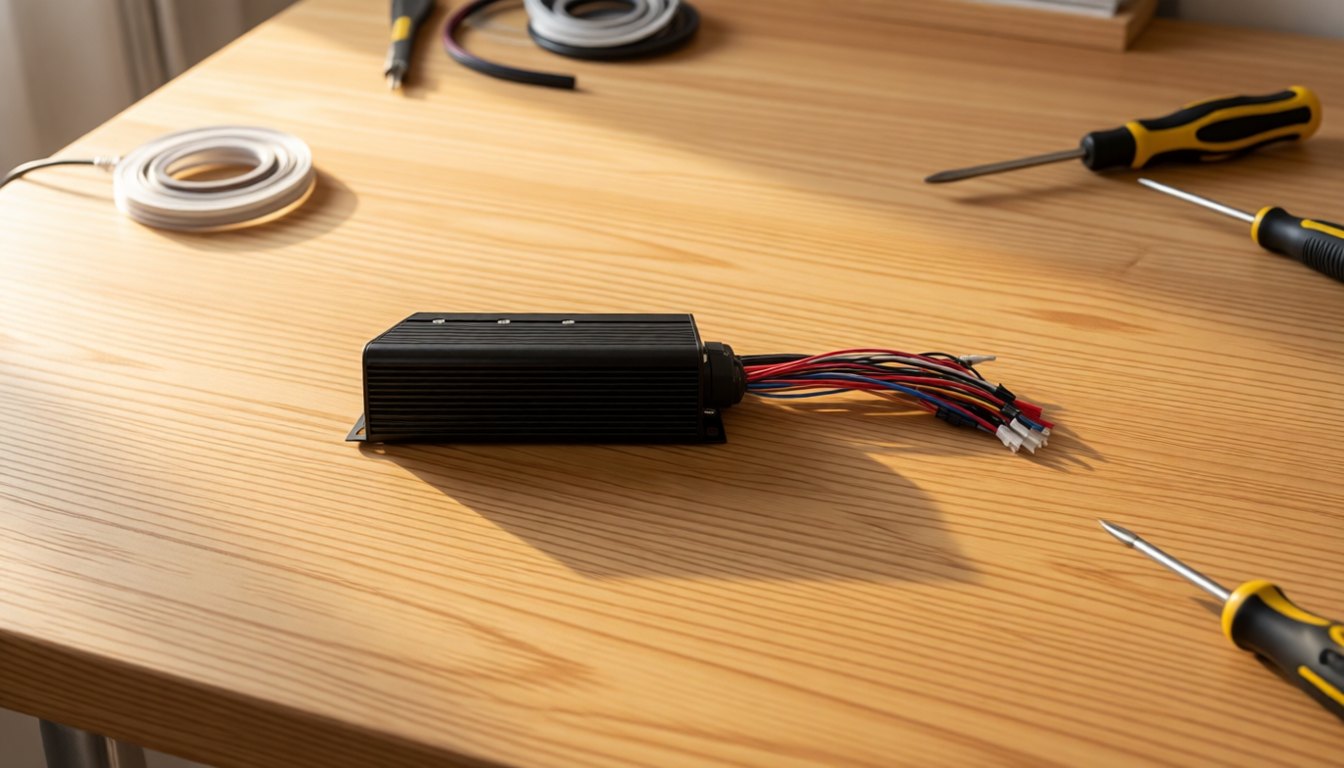
E-bike motors are brushless DC motors, so something has to switch the current. That is the controller: power transistors (MOSFETs) that switch battery current through the motor’s three phase wires in the right order, so the rotor keeps getting pulled round. Everything plugged into it tells it where the rotor is, how much power you want, or when to stop:
- Phase wires (3 thick wires): carry the motor current.
- Hall sensor plug (usually 5 thin wires): reports the rotor position (section 5).
- PAS (pedal assist sensor): tells the controller you are pedalling, so assistance starts and stops with your legs.
- Throttle: sends a variable voltage. The KT controller we sell, for example, lists a 1–4.2 V speed signal input.
- Brake cut-offs: switches in the levers that cut motor power when you brake. They are either low-level (the switch pulls the signal to ground) or high-level (the switch supplies a voltage), and must match the controller.
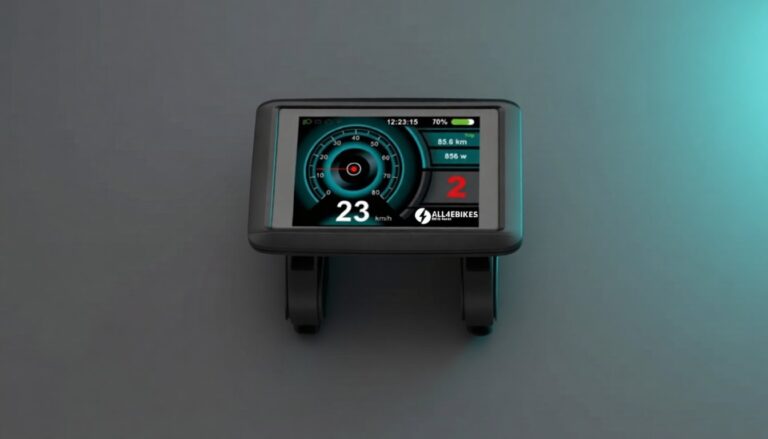
- Display: shows speed, battery and assist level, and on most systems holds settings such as wheel size and the speed limit.
The controller also limits current, and cuts out when battery voltage gets too low (the low-voltage cut-off) so the cells are not drained too far.
On a hub motor kit the controller is a separate box on the frame. On a Bafang BBS01, BBS02 or BBSHD mid-drive it is built into the motor casing. See our rear hub vs mid-drive guide for the trade-offs.
48V, 52V and 72V Controllers: The Range Must Cover Full-Charge Voltage
Batteries are sold by nominal voltage, but a lithium-ion pack sits well above that off the charger. Each cell charges to 4.2 V and the cells are in series, so full charge is cells × 4.2 V:
| Nominal battery | Cells in series | Full-charge voltage |
|---|---|---|
| 36 V | 10 | 42.0 V |
| 48 V | 13 | 54.6 V |
| 52 V | 14 | 58.8 V |
| 60 V | 16 | 67.2 V |
| 72 V | 20 | 84.0 V |
A controller’s MOSFETs and capacitors have a maximum voltage. Exceed it and the controller can fail the first time you ride off a full charge. So a controller sold “for 48 V” is not automatically safe on 52 V (58.8 V against 54.6 V). Only fit a 52 V battery if the controller says it supports 52 V.
The opposite mistake matters too. A 48 V controller’s low-voltage cut-off (about 39 V on the JYTcon) sits right next to the 42 V a full 36 V pack delivers, so on a 36 V battery it will cut out early or may not run at all.
Look for the rated input range and a maximum voltage. For a 48 V controller, typical labels are “36–48 V” (like the KT) or “48–52 V”. For a 72 V controller, remember the pack charges to 84 V, so ask what the maximum is before you buy: our 48V–72V 45A is listed for 48, 60 and 72 V, and the Sabvoton 200A is rated 24–72 V with a stated 90 V maximum, which leaves headroom above 84 V. For choosing the pack itself, see our 36V vs 48V vs 52V vs 72V battery guide.
Amps, Watts and Your Battery’s BMS
The amp figure on a controller is its battery current limit: the most it will draw from the pack. Multiply it by battery voltage for a rough peak power figure:
Peak power ≈ volts × amps. A 48 V pack and a 30 A controller gives roughly 48 × 30 = 1,440 W at the battery when the controller is at its limit. Voltage sags under load and some power is lost as heat, so the wheel sees less.
That is why the same setup feels stronger on 52 V than on 48 V: same amps, more volts. A motor’s wattage is its rated continuous power; the controller’s amp limit sets the peak.
Three ratings have to agree:
- Controller current limit: how hard the controller pulls on the battery.
- Battery BMS continuous rating: how much current the battery’s management board allows before it shuts the pack off. It must be at least the controller’s limit, or the BMS trips on hills and hard starts and the bike goes dead until you switch it off and on.
- Motor rating: a motor fed far more current than it is built for runs hot, and heat is what damages windings, hall sensors and, in geared hubs, the nylon gears.
Bigger controllers also list phase current. At low speed the controller chops the battery voltage down, so the motor sees lower voltage but higher current: the Sabvoton 200A lists 200 A battery and 450 A phase current.
Sine Wave Controller vs Square Wave (and Where FOC Fits)
This is about the shape of the current sent down the phase wires.
A square wave controller (also called trapezoidal or six-step) switches the phases in six fixed steps per electrical turn. At any moment two phases carry current and one is off, and the current jumps from pair to pair. It is simple, cheap and robust. The downside is a ripple in torque at each switch, which you hear as a whine or buzz and can feel as a slightly rough pull at low speed.
A sine wave controller shapes the current in all three phases into smooth waves that rise and fall as the rotor turns. Smoother current gives you:
- Noise: noticeably quieter.
- Smoothness: less torque ripple, so pull-away feels more even.
- Efficiency and heat: a modest gain; don’t expect much more range.
FOC (field oriented control) is a more advanced form of sine wave control: the controller measures the phase currents, works out where the rotor’s field is, and continuously keeps the motor’s field at the most effective angle to it. In our range, the Sabvoton 200A is listed as FOC sine wave and learns the motor’s electrical angle automatically; the 60A 3000W controller is listed as sine wave.
Hall Sensors: Sensored vs Sensorless Start-Up
Hall sensors are three small magnetic sensors inside the motor that switch on and off as the rotor turns, telling the controller which phase to drive next. Their plug typically has five wires: a 5 V supply, ground and three signals.
A sensored controller knows the rotor position at a standstill, so it starts smoothly and strongly from zero. A sensorless controller works the position out from the voltage the spinning motor generates (back-EMF). A stationary motor generates nothing, so you get a judder when pulling away, especially under load, though it runs fine once moving.
Some controllers can fall back to sensorless running if a hall sensor fails, so a bike that suddenly judders from a standstill but rides normally once moving often has a hall fault.
Hub Controllers vs Bafang Controllers: UART and CAN-BUS
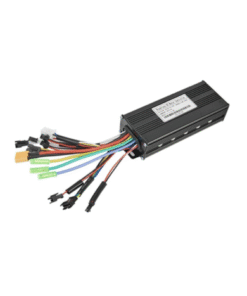
Generic hub motor controllers (KT, JYTcon and similar) are separate boxes with leads for the battery, phases, halls, PAS, throttle, brakes and display. Controllers often work across makers when voltage, current, connectors and wiring match, but not always, and displays must suit the controller type. Our 30 A, 35 A, 45 A and 60 A controller pages list the SW900 and UKC1+ displays as compatible, depending on wiring and configuration.
Bafang mid-drive controllers are part of the motor and made for one motor family:
- Motor model: a BBS01 controller for a BBS01, a BBS02 controller for a BBS02B, a BBSHD controller for a BBSHD. They are not interchangeable.
- Protocol: Bafang systems talk to the display using UART or CAN-BUS, and the controller, display and harness must all use the same one. Our BBSHD CAN-BUS controller page states it is not compatible with UART displays or wiring harnesses.
- Voltage: our BBS02 controllers are listed for 48 V, the BBSHD CAN-BUS controller for 48 V and 52 V, and the BBS01 controller for 36 V.
UART is the long-standing protocol; our BBS02 UART page notes it is generally more compatible with aftermarket displays and programming tools, which DIY builders like. CAN-BUS is newer, with less signal interference between motor, display and battery management system, but every part must be CAN-BUS.
To find out which you have, check the label on the motor or controller and your display model, or send us photos. Before ordering any Bafang controller, run through our full Bafang compatibility check.
The Controllers We Stock, Compared (Sabvoton, 48V, 72V, Bafang)
Every figure comes from our product pages (October 2026). A dash means the page doesn’t state it; ask us. Prices are approximate. The full range is on our e-bike controllers page.
| Controller | Made for | Battery | Current | Type / protocol | Approx. price (Oct 2026) |
|---|---|---|---|---|---|
| KT 36V/48V 17A | 250–350 W brushless hub motors | 36–48 V | 17 A ±1 A | 6-MOSFET, low-level brake input | £36 |
| JYTcon 48V hub controller | 48 V hub motors with Hall wiring (not Bafang mid-drives) | 48 V (cut-off ~39 V) | 20 A | Waterproof round connectors + XT60 | £66 |
| 48V–52V 30A | 1000 W brushless hub motors | 48 V and 52 V | 30 A | Over-current, short-circuit and thermal protection | £60 |
| 48V–52V 35A | 1500 W brushless hub motors | 48 V and 52 V | 35 A | — | £70 |
| 48V–72V 45A | 2000 W brushless hub motors | 48 V, 60 V, 72 V | 45 A | — | £90 |
| Sine wave DC 60A | 3000 W brushless hub motors | Listed as 72 V compatible | 60 A | Sine wave | £110 |
| Sabvoton 200A (SVMC72200) | High-power hub motors and EV builds | 24–72 V rated, 90 V max | 200 A battery, 450 A phase | FOC sine wave, regen braking, CAN optional, app/PC programmable | £400 |
| Bafang BBS01 250W | Bafang BBS01 mid-drive | 36 V | — | — | £85 |
| Bafang BBS02 750W UART | Bafang BBS02B mid-drive | 48 V | — | UART | £100 |
| Bafang BBS02 750W CAN-BUS | Bafang BBS02B mid-drive | 48 V | — | CAN-BUS | £105 |
| Bafang BBSHD 1000W | Bafang BBSHD mid-drive | — | — | — (ask us) | £146 |
| Bafang BBSHD 1000W CAN-BUS | Bafang BBSHD CAN-BUS mid-drive | 48 V and 52 V | 30 A | CAN-BUS (not UART) | £175 |
Reading the table:
- Looking for a 72V controller? The 45 A and the Sabvoton are listed for 72 V; the 60 A is described as 72 V compatible but gives no voltage range, so ask us first.
- The Sabvoton controller is a different class: 2.2 kg and set up through PC or app software, for experienced builders. Its regen braking only works with a direct-drive hub motor, because a geared hub free-wheels when you slow down.
Mounting and Waterproofing
Our controller pages list water ingress among the common causes of failure, and that matches what we see on the bench: hub kit controllers and connectors catch wheel spray, and water sitting in a plug corrodes the pins over a winter.
- Mount it high and sheltered, out of the direct line of spray.
- Point connectors down where you can, with a small drip loop in each cable.
- Leave airflow: the casing sheds heat, so don’t wrap it in foam or tape.
- Never jet-wash the controller, motor or connectors.
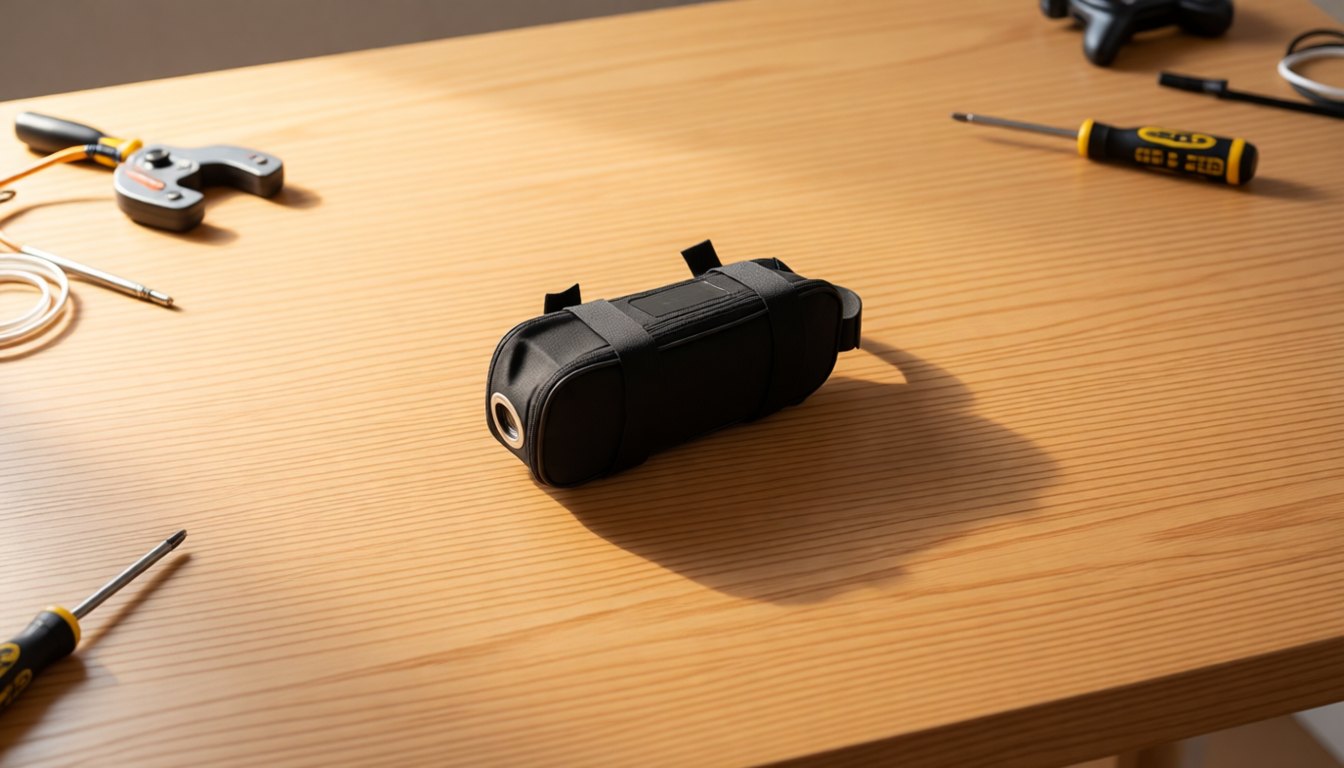
Our controller bag for 250W–2000W hub controllers (27 × 9.5 × 7 cm) straps to a frame tube with a grommet for the cables. Its page is clear that it is weather-resistant, not waterproof, and not for Bafang mid-drives, where the controller is sealed inside the motor.
Signs of a Failing Controller
Controllers get blamed for faults that are really the battery, a connector or a sensor:
| Symptom | Could be the controller, but also check |
|---|---|
| Motor not powering on, display works | Brake cut-off stuck on, loose motor plug, failed hall sensor |
| Display communication error | Display cable or plug, battery not holding voltage under load |
| Cuts out on hills or hard starts | BMS rated below the controller’s current, or a weak battery |
| Judders from a standstill, fine once moving | Hall sensor or hall wiring |
| Burning smell, hot casing | Stop riding, disconnect the battery and get it checked |
Our symptom-by-symptom diagnostic guide goes deeper, and if your display shows a number, start with Bafang display error codes explained.
The checks we do before condemning a controller:
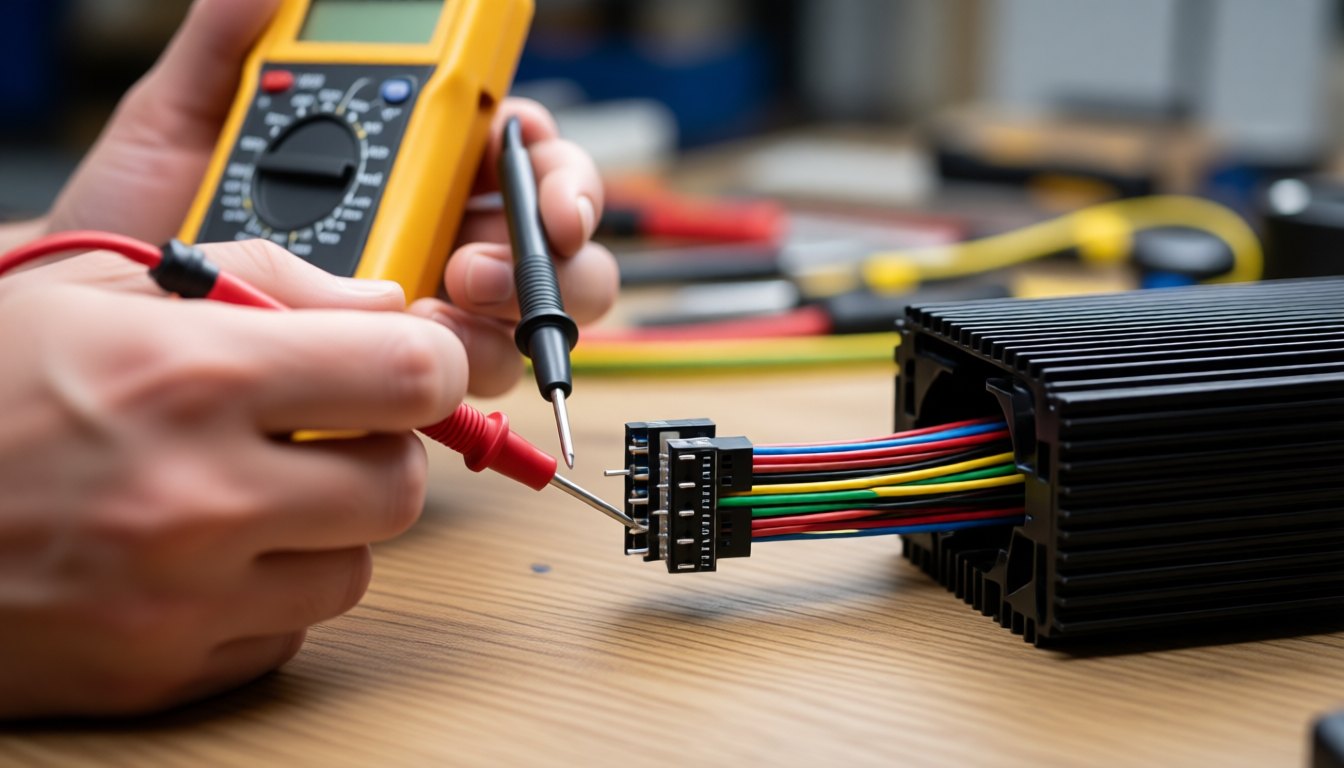
- Voltage at the controller input: should match the battery’s resting voltage. If not, the fault is upstream (battery, switch, fuse or connector).
- Hall signals: with the wheel lifted clear of the ground, the system on and the wheel turned slowly by hand, each signal wire should switch between roughly 0 V and the supply voltage. One stuck at a fixed value points to a hall fault.
- Brake cut-offs: with the system off, unplug them one at a time, then switch on; if the motor suddenly works, a switch was stuck on.
Work safely. An e-bike battery can deliver very high currents. Disconnect it before unplugging phase wires or opening anything, never short the battery or phase leads, and don’t reconnect a controller that has smelt of burning. Replacing a Bafang controller means working on the motor itself; if in doubt, book it in.
If you would rather we found the fault, our service and repair workshop in Cardiff tests hub and mid-drive systems on the bench.
Road-Legal or Private Land?
In the UK an e-bike is road-legal as an electrically assisted pedal cycle (EAPC): a motor of no more than 250 W continuous rated power, assistance that cuts out at 15.5 mph, working pedals, and a rider aged 14 or over.
Most controllers here are for systems rated well above 250 W (the KT is 250–350 W, the rest run from 750 W up to 3000 W and beyond), and those builds are for private land only. For a road bike, use a 250 W kit with its matching controller, cutting out at 15.5 mph. Our guide Is an eBike Conversion Kit Legal in the UK? covers the exact conditions, and if you are tempted to raise a kit’s limit, read Thinking of Derestricting a Bafang Kit? Read This First.
Checklist Before You Order
Check these yourself, or send them to us:
- Motor: hub or mid-drive and its wattage. For Bafang, the model (BBS01, BBS02B or BBSHD) and serial number.
- Battery: nominal voltage, and the BMS continuous current rating if you know it.
- Display model, and for Bafang, UART or CAN-BUS.
- Connectors: clear photos of the motor plug, battery connector and the plugs on your old controller.
FAQ
What does an electric bike controller do?
It switches battery current through the motor’s three phase wires, based on signals from the pedal sensor, throttle, brake cut-offs and display, and cuts out when battery voltage gets too low.
Can I use a 48V controller with a 52V battery?
Only if the controller is rated for 52V. A 52V pack charges to 58.8V, against 54.6V for a 48V pack, and that can damage a controller built only for 48V.
Is a sine wave controller better than a square wave controller?
It is quieter and smoother, especially at low speed, and slightly more efficient. Square wave works fine, just noisier.
How many amps should my e-bike controller be?
Enough for your motor, but no more than your battery’s BMS can supply continuously. Peak power is roughly volts times amps: 30A on 48V is about 1,440W.
Can I put any controller on a Bafang BBS02 or BBSHD?
No. Each Bafang mid-drive controller is made for one model, and its protocol must match your display and wiring: UART with UART, CAN-BUS with CAN-BUS.
How do I know if my e-bike controller is bad?
No motor power while the display works, cutting out, erratic power or display communication errors. Battery, connector, hall and brake cut-off faults look similar, so test those first.
Is a 72V controller road legal in the UK?
Not as a high-power build. UK road legality depends on a motor of no more than 250W continuous rated power that stops assisting at 15.5 mph, not on voltage alone. A 72V high-power setup is for private land only.
What is a Sabvoton controller?
A programmable FOC sine wave controller. Our Sabvoton 200A (SVMC72200) is rated 24-72V (90V maximum) with 200A battery and 450A phase current, set up by PC or app. It is for experienced builders of high-power private-land projects, not a 250W road kit.