

Family Cycling Holidays UK: E-Bike Routes and Tips
Short answer
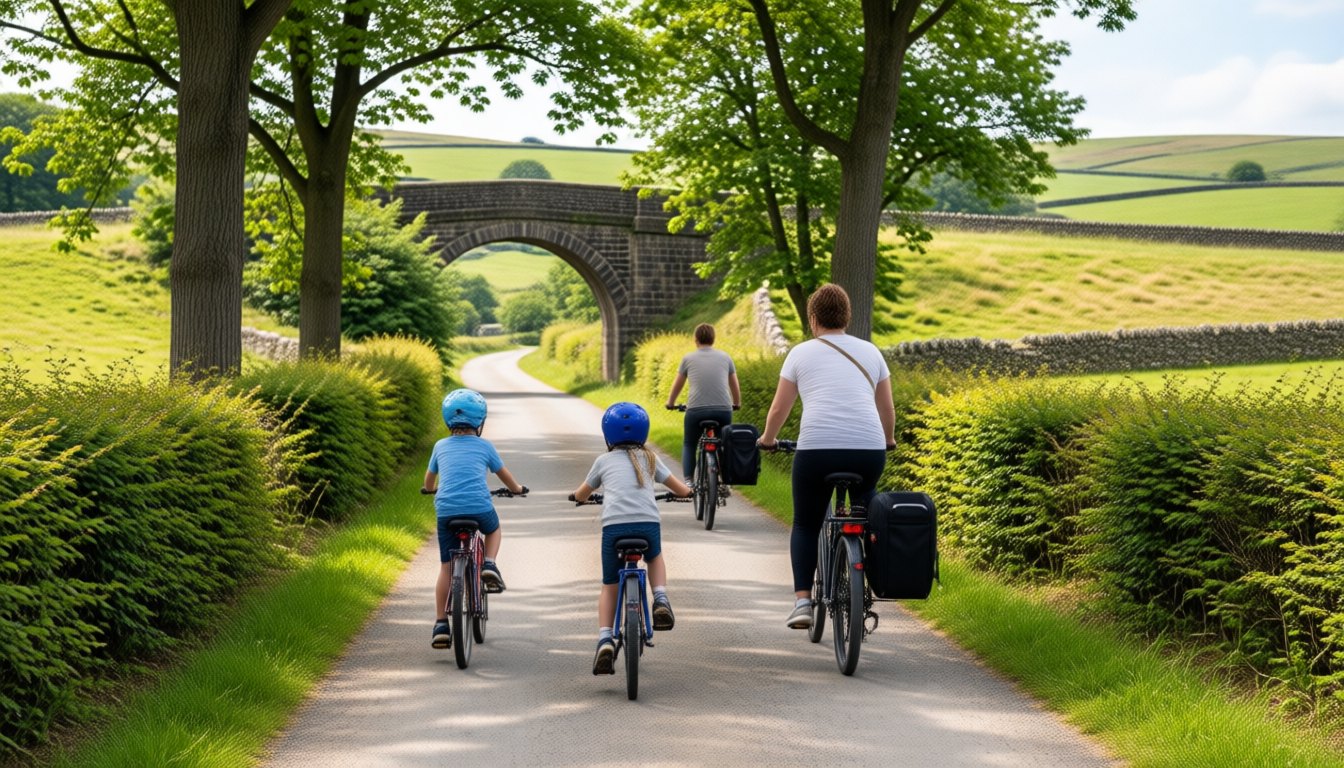
The easiest family cycling holidays in the UK use traffic-free paths on old railway lines, such as the Camel Trail, the Bristol & Bath Railway Path and the Tissington and Monsal Trails, plus the Taff Trail from Cardiff. The usual set-up is one adult on an e-bike carrying the gear and the children on normal bikes, because you must be 14 or over to ride an e-bike in Great Britain.
Who this is for: parents planning a few days of riding with children, where at least one adult rides an e-bike. Route facts come from Walk Wheel Cycle Trust (the new name for Sustrans) and the Peak District National Park, checked in October 2026.
Choosing Family Routes in the UK
For family bike rides in the UK, look for three things: traffic-free, flat and easy to cut short. Old railway lines tick all three, because railways were built with gentle gradients. Here are six worth knowing:
- Taff Trail (Cardiff to Brecon, National Route 8): 55 miles in total and about 70% traffic-free, on mixed surfaces. You don’t need to ride it all. The southern end follows the Taff out of Cardiff past Castell Coch towards Pontypridd. Further north it climbs the Torpantau Pass and some sections suit a sturdier bike, so keep that end for older children or adults.
- Camel Trail (Cornwall): about 12 miles from Padstow via Wadebridge to Bodmin and Wenford Bridge. It’s largely flat, about 92% traffic-free and mostly asphalt, with short on-road bits through Wadebridge and into Bodmin.
- Bristol & Bath Railway Path (Route 4): 13.9 miles, almost entirely flat and nearly all asphalt, with stations near both ends. It’s a good choice for a first longer day.
- Tissington Trail (Peak District, Route 68): 13 miles from Ashbourne to Parsley Hay, fully traffic-free on a former railway, mostly firm unsealed surface. It’s mostly flat, with one steeper incline at Mappleton. There’s bike hire at both Ashbourne and Parsley Hay.
- Monsal Trail (Peak District): about 8.5–8.9 miles between Bakewell and Blackwell Mill, fully traffic-free and mostly firm unsealed path. Its four lit railway tunnels are a highlight for children, each about 400 m long. The lights are daylight-controlled and switch off around 4:30pm in winter, so carry lights.
- Keswick to Threlkeld (Lake District): 3.2 miles each way through the wooded Greta Gorge, fully traffic-free, with bridges and a boardwalk. Short enough for young children.
Check the route page for closures before you set off. The Walk Wheel Cycle Trust Taff Trail page shows what to look for: length, traffic-free share, surface and the sections that need a sturdier bike.
One E-Bike, Several Kids: Mixed Family Groups
The usual set-up is adults on e-bikes and children on normal bikes. It works, as long as the e-bike rider remembers the children are doing all their own work.
- Ride at the slowest rider’s pace. Use the lowest assist level, or none on the flat, and ride behind the youngest child, not in front.
- Let the e-bike carry the load. Panniers with the picnic, the spares, the waterproofs and the children’s layers mean they ride light.
- Plan short legs with a reward. A café, a tunnel, a castle or a beach every few miles works better than a big total.
- Have a bail-out. Choose routes with a station, a car park or a bus stop part-way, so a tired child doesn’t end the day for everyone.
Child seats and trailers on e-bikes. Both can work, but an e-bike is not a normal bike for fitting them. The battery may sit where a frame-mounted seat would clamp, a rear hub motor changes the axle a trailer hitch uses, and the extra weight makes the bike handle differently at low speed. Before you buy, check three things in writing:
- that the bike or frame maker allows a child seat or trailer on that frame;
- the rear rack’s load rating, if the seat mounts to the rack, and the seat’s own limits for the child’s weight and age;
- that the trailer hitch fits your axle type, and the trailer maker’s limits.
Practise in a quiet car park before the trip, with the child on board and at walking pace. Pull away in a low assist level, because the first push of the motor feels stronger with a passenger.
UK E-Bike Rules That Matter for Families
In Great Britain, an e-bike can be ridden like a normal bicycle if it meets the electrically assisted pedal cycle (EAPC) rules on GOV.UK:
- it has pedals that can be used to propel it;
- the motor’s continuous rated power is no more than 250 W;
- the motor doesn’t assist above 15.5 mph;
- the rider is 14 or over.
The age rule is the one families forget. Under-14s can’t ride an e-bike, even on a traffic-free path, so the children ride normal bikes or travel in a seat or trailer. A bike that can be propelled without pedalling (a “twist and go”) needs approval to count as an EAPC. For conversion kits, see whether an e-bike conversion kit is legal in the UK.
Derestricted or full-throttle bikes are not EAPCs. Legally they’re motor vehicles, and they don’t belong on a family path. If your kit has been derestricted or fitted with a throttle, read our article on derestricting a kit and why most kits ship pedal-assist only.
Getting There: Car Racks and Trains
By car. Most families drive with the bikes on a rack. E-bikes are heavy, so check the rack’s limit for each bike position and, on a towbar rack, your car’s towbar nose weight. Then take the battery and the display off for the drive.
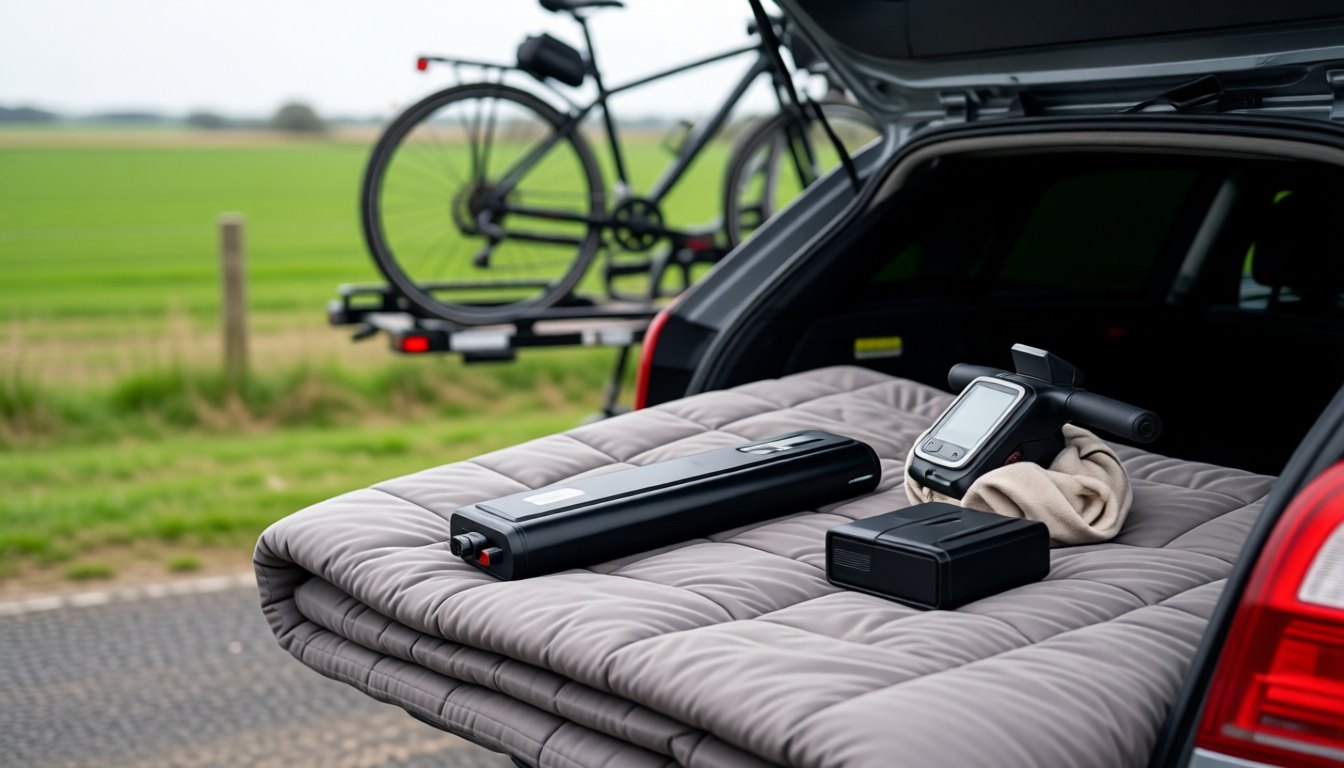
On a rack, a battery gets road spray, motorway buffeting and direct sun. Padded inside the car, out of the sun, it’s safer, and the bike is lighter to lift. Cover the bike’s exposed connectors, and pack the charger with the battery so it can’t be left behind.
By train. E-bikes on UK trains are possible, but every operator sets its own rules, and spaces are few. Two examples:
- Transport for Wales: pedal-assist e-bikes are carried under its cycle policy. Most trains have space for up to two cycles, reservations are free and strongly advised, and bikes aren’t allowed on some Valleys and Cardiff local routes at peak times or on rail replacement buses.
- LNER: bike reservations are compulsory on all services and free. E-bikes must weigh under 25 kg, and you can’t charge them on the train.
That 25 kg limit rules out many e-bikes, and two spaces per train doesn’t go far with a family. Check each operator’s page for every train on your journey, book the spaces when you buy the tickets, and take the panniers off before lifting the bike on.
Range and Charging on a Family Trip
Riding at a child’s pace is often easy on the battery. But a loaded bike, stop-starts, cold mornings, a seat or trailer and higher assist on the climbs all cost range.
- Test at home, fully loaded. Ride a loop with the panniers, seat or trailer on, and note how much battery it uses.
- Plan well under your tested range, so a detour or a headwind isn’t a problem.
- Ask before you book. Check that your cottage, campsite or B&B lets you charge an e-bike battery indoors. Don’t assume.
- Charge where you can see it: on a hard floor, away from anything flammable, never on a bed, a carpet or a tent groundsheet, and not overnight on an escape route.
Our e-bike performance calculator gives you a starting estimate. Choosing between 36V, 48V, 52V and 72V batteries explains how voltage and capacity become range, and how long e-bike batteries last covers the signs of a tired pack. For the charging itself, read how to charge your e-bike safely, and if you’re buying a spare charger for the holiday, our e-bike charger guide explains what fits.
Workshop Prep Before You Go
Many holiday breakdowns can be found on the bench at home. Allow two weeks before you leave, so there’s time to order a part, and check the children’s bikes too.
- Brakes: replace pads near the limit. A loaded e-bike, or one pulling a trailer, works its brakes hard.
- Tyres: look for cuts, worn tread and cracked sidewalls, and set the pressures for the load. Several of these trails are firm gravel, where a slightly wider tyre is kinder.
- Chain: measure it. A stretched chain on a mid-drive wears the cassette and chainring fast.
- Connectors: check every plug between battery, controller, motor and display for corrosion or a loose fit.
- Battery: if the range has dropped or the pack cuts out under load, get it tested before the trip.
Spares: inner tubes for every wheel size in the group (children’s bikes often differ), tyre levers, a pump, a multitool, a chain quick link, spare brake pads, zip ties and electrical tape.
If the display shows an error: stop, photograph the code, switch off and on again, and check the battery contacts and display plug. A bumpy day often loosens a connection. Look the code up in our Bafang display error codes guide or the conversion kit diagnostic guide. On one of our kits, send us the photo on WhatsApp and we’ll tell you whether it’s safe to keep riding.
Going Further: Bavaria
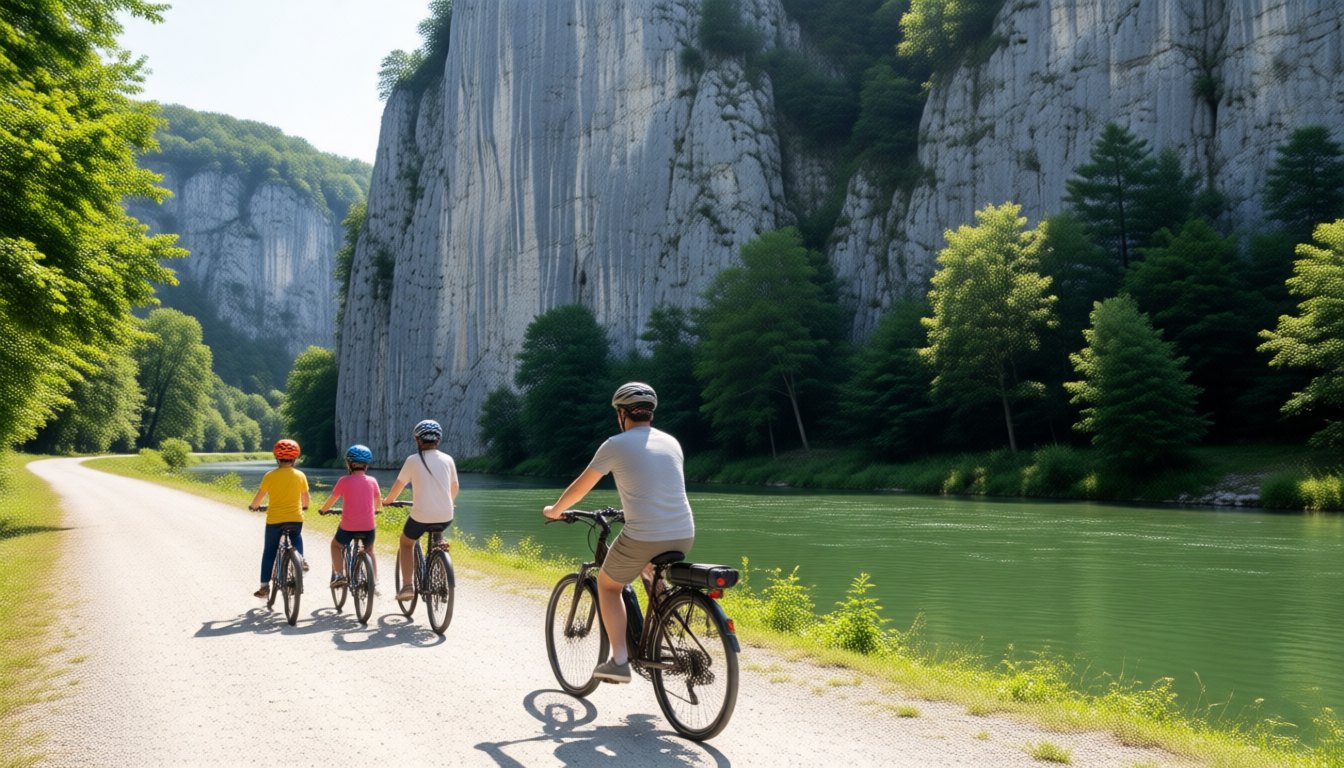
Once your family has a few UK trails behind them, Bavaria’s flat river paths along the Danube and through the Altmühltal are an easy step abroad. You’ll be driving rather than flying, because you can’t take a normal e-bike battery on a plane. A UK-legal EAPC works there because Germany’s Pedelec rules match ours: 250 W, assistance only while pedalling, cutting out at 25 km/h. For a day where someone else plans the route, AbenteuerBayern runs guided and self-guided explorer bike tours around Ingolstadt, including a family tour and a self-guided treasure hunt by bike, all offered in English as well as German.
Checklist and Route Summary
- Before booking: pick a traffic-free route with a bail-out point, and check the route page for closures.
- Accommodation: confirm you can charge an e-bike battery indoors.
- Two weeks out: service every bike in the group, plus a battery test on the e-bike.
- Child seat or trailer: check the frame, rack and trailer maker’s approval and limits, then practise.
- Transport: a rack rated for the weight, connector covers, and the battery padded inside the car. Or book train bike spaces for every leg.
- Spares: tubes for every wheel size, levers, pump, multitool, quick link, pads, zip ties, tape.
- Kit: charger, lights (for tunnels and late afternoons), waterproofs, snacks.
| Route | Length | Surface | Best for |
|---|---|---|---|
| Taff Trail, Cardiff to Brecon | 55 miles (about 70% traffic-free) | Mixed; some sections need a sturdier bike | Short rides from Cardiff; older children further north |
| Camel Trail, Padstow to Bodmin | About 12 miles | Mostly asphalt, some firm path | Younger children, a seaside start |
| Bristol & Bath Railway Path | 13.9 miles | Almost all asphalt | A first longer day, train at each end |
| Tissington Trail, Ashbourne to Parsley Hay | 13 miles | Mostly firm unsealed, some asphalt | Families, with bike hire at both ends |
| Monsal Trail, Bakewell to Blackwell Mill | About 8.5–8.9 miles | Mostly firm unsealed | Children who like tunnels |
| Keswick to Threlkeld | 3.2 miles each way | Mostly firm unsealed, a boardwalk | The youngest riders, a short gorge ride |
FAQ
Can my child ride an e-bike in the UK?
Not if they are under 14. GOV.UK says you can ride an electric bike if you are 14 or over, so younger children ride normal bikes or travel in a child seat or trailer.
What are the best traffic-free family cycle routes in the UK?
Old railway paths are the easiest: the Camel Trail in Cornwall, the Bristol & Bath Railway Path, the Tissington and Monsal Trails in the Peak District, Keswick to Threlkeld in the Lake District, and the southern end of the Taff Trail from Cardiff.
Can I fit a child seat or trailer to an e-bike?
Often, yes, but check first. Confirm that the bike or frame maker allows it, check the rear rack’s load rating and the seat’s limits, and make sure the trailer hitch fits your axle. Practise at walking pace before the trip.
Can I take an e-bike on a UK train?
Usually, but each operator has its own rules. Transport for Wales carries pedal-assist e-bikes and advises a free reservation, with space for up to two cycles on most trains. LNER requires a reservation and only takes e-bikes under 25 kg.
How should I carry an e-bike on a car rack?
Use a rack rated for the bike’s weight, check your towbar nose weight, and take the battery and display off. Pad the battery inside the car, out of the sun, and cover the bike’s exposed connectors.
Can I charge my e-bike at a holiday cottage or campsite?
Ask before you book, as not everywhere allows it. Charge on a hard floor where you can see it, away from anything flammable, never on a bed, carpet or tent groundsheet.
Can I take my UK e-bike to Bavaria?
Yes, if it is a UK-legal EAPC, because Germany’s Pedelec rules match: 250 W, assistance only while pedalling, cutting out at 25 km/h. You will need to drive rather than fly, as normal e-bike batteries are too big for passenger flights.
Planning a family trip on one of our kits? Message George on WhatsApp or book a service before you go.