

Ebike Charger Guide: Voltage, Plugs and Charge Time
In this article
- Charger Voltage: Why a 48V Battery Needs a 54.6V Charger
- Electric Bike Charger Plugs: 3-Pin XLR vs DC 5.5 × 2.1 mm Barrel
- Why “It Fits” Is Not Enough: The Danger of the Wrong Voltage
- Charger Amps vs Charge Time: How Long Does an E-Bike Battery Take?
- Is a Fast Charger Bad for the Battery?
- Signs of a Faulty Charger
- UK Safety Basics (Kept Short)
- Which Charger Do I Need? Battery → Charger → Product
- FAQ
Short answer
A charger must match your battery in two ways: its full-charge voltage and its plug. Do not use the number on the sticker: 36V needs 42V, 48V needs 54.6V, 52V needs 58.8V, 60V needs 67.2V and 72V needs 84V. The plug is usually a 3-pin XLR or a 5.5 x 2.1 mm DC barrel. The amps only decide how fast it charges.
Who this is for: riders with a conversion kit battery or a generic lithium-ion pack who have lost, broken or outgrown their charger. Branded systems such as Bosch, Shimano or Yamaha use their own chargers, so buy the manufacturer’s replacement.
Charger Voltage: Why a 48V Battery Needs a 54.6V Charger
The voltage printed on a battery is its nominal voltage: the average it sits at while you ride. A charger, though, has to push the pack up to its full-charge voltage, which is always higher. That is why chargers are labelled by their output (42V, 54.6V, 58.8V, 84V) and not by the battery they suit.
The maths is simple once you know what is inside the case. An e-bike battery is built from lithium-ion cells (usually 18650 or 21700 size) wired in series. Each standard lithium-ion cell is about 3.6–3.7 V nominal and is fully charged at 4.2 V. Multiply the number of cells in series by 4.2 V and you have the charger voltage you need.
| Battery (nominal) | Cells in series | Full-charge voltage | Charger to look for |
|---|---|---|---|
| 36V | 10S | 10 × 4.2 = 42.0V | 42V charger |
| 48V | 13S | 13 × 4.2 = 54.6V | 54.6V charger |
| 52V | 14S | 14 × 4.2 = 58.8V | 58.8V charger |
| 60V | 16S | 16 × 4.2 = 67.2V | 67.2V charger |
| 72V | 20S | 20 × 4.2 = 84.0V | 84V charger |
“10S” means ten cell groups in series. Capacity (Ah) has no effect on the charger voltage: a 48V 13Ah pack and a 48V 30Ah pack both need a 54.6V charger.
This table is for standard lithium-ion packs only. Lithium iron phosphate (LiFePO4) batteries use a different cell voltage (about 3.65 V per cell when full), so their chargers are different, and so are older lead-acid packs. The batteries we list are lithium-ion. If your battery label says LiFePO4, or says nothing at all, check before you buy anything.
To find your battery’s voltage, check the label on the case or the “Output” line on the original charger. Unsure whether you have a 48V or 52V pack? Our guide to choosing between 36V, 48V, 52V and 72V batteries explains the differences.
Electric Bike Charger Plugs: 3-Pin XLR vs DC 5.5 × 2.1 mm Barrel
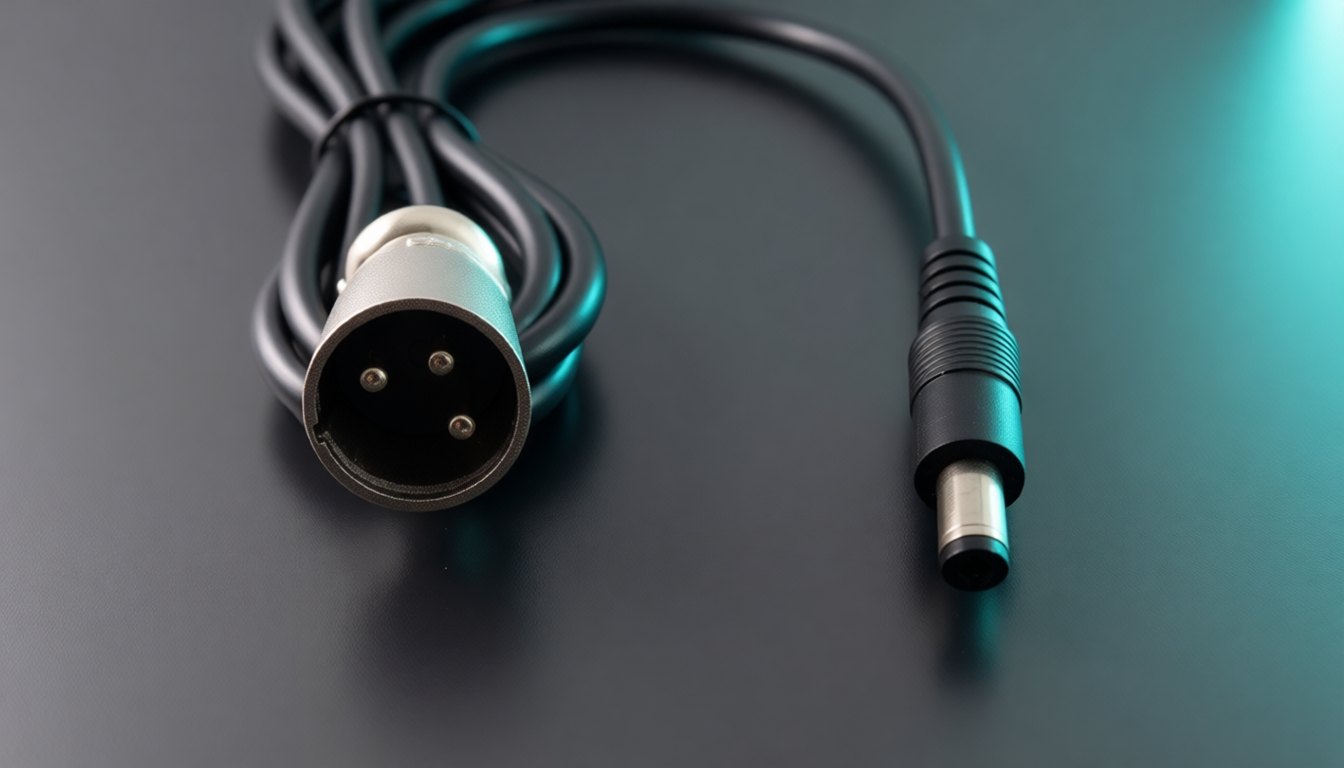
The second match is the plug. Our lithium battery chargers come with one of two connectors, and they are not interchangeable:
- DC barrel, 5.5 × 2.1 mm: a small, round plug with a hollow centre. On our range it is the usual charging port on downtube and Hailong-style batteries, across 36V, 48V and 52V packs.
- 3-pin XLR: a larger, round, locking connector with three pins, the same family as a microphone plug. It is more common on triangle batteries, high-capacity packs and 72V batteries, and copes better with higher charging currents.
How to check yours:
- Look at the port on the battery. Three pin holes in a round socket means XLR. A single round hole with a pin in the middle means a DC barrel.
- Check the old charger’s plug if you still have it. It is the easiest reference.
- Measure a DC barrel if you can. A 5.5 × 2.1 mm plug and a 5.5 × 2.5 mm plug look almost the same. A 2.1 mm plug will not go onto a 2.5 mm centre pin, and a 2.5 mm plug on a 2.1 mm pin can make a loose, intermittent contact that heats up.
- Something else? Some packs use other connectors. Send us a photo before you order.
A word on “3 pin”. When an e-bike charger is described as “3 pin”, it normally means the 3-pin XLR plug that goes into the battery. It does not describe the mains plug. If what you actually need to know is whether a charger has a UK three-pin mains plug, ask us to confirm the mains lead before you order.
Even two XLR plugs are not a guarantee of a match: the pin layout (which pin is positive) is not standardised across every battery maker. If your battery came from another supplier, confirm the polarity with us or with that supplier first.
Why “It Fits” Is Not Enough: The Danger of the Wrong Voltage
A 54.6V and a 58.8V charger can both have an XLR plug and both click into the same battery. The plug tells you nothing about the voltage. Here is what happens cell by cell when the voltage is wrong:
| Charger | Battery | Per cell at the end of charge | What happens |
|---|---|---|---|
| 58.8V (52V charger) | 48V, 13S | 58.8 ÷ 13 = 4.52V | Overcharge. Only the BMS stands between you and a damaged, unsafe pack. |
| 84V (72V charger) | 60V, 16S | 84 ÷ 16 = 5.25V | Severe overcharge. Never do this. |
| 54.6V (48V charger) | 52V, 14S | 54.6 ÷ 14 = 3.9V | Not dangerous in itself, but the pack never fills, so you lose range. Some BMSs may not start charging at all. |
| 42V (36V charger) | 48V, 13S | 42 ÷ 13 = 3.23V | The pack barely charges. |
Every decent battery has a BMS (battery management system), which should cut off charging if any cell group goes above its safe voltage. So why worry? Because a BMS is a safety net, not a charger. If its overcharge protection has failed, which can happen with age, water ingress or a previous fault, nothing stops the cells going above 4.2 V. Overcharged lithium-ion cells heat up, can swell and, in the worst case, go into thermal runaway: a fire that is very hard to put out.
Never use a higher-voltage charger to “charge faster”. Faster charging comes from more amps at the correct voltage, never from more volts. And don’t charge a battery with a charger you have adapted or rewired to make the plug fit.
Charger Amps vs Charge Time: How Long Does an E-Bike Battery Take?
Once the voltage and plug are right, the amp rating (A) decides how long charging takes. A lithium-ion charger works in two stages:
- Constant current: the charger delivers its full rated amps while the battery voltage climbs. This stage puts in roughly the first 80–90%.
- Constant voltage: once the pack reaches the full-charge voltage, the charger holds that voltage and the current tapers off. The BMS also uses this time to balance the cells.
That gives a practical rule of thumb:
Charge time (hours) ≈ battery capacity (Ah) ÷ charger current (A) + roughly 30–60 minutes to finish.
Example: a 20Ah battery on a 5A charger ≈ 20 ÷ 5 = 4 hours, plus up to an hour to top off.
| Battery capacity | 2A charger | 3A charger | 5A charger |
|---|---|---|---|
| 10Ah | about 5.5–6 h | about 4 h | about 2.5–3 h |
| 13Ah | about 7–7.5 h | about 5 h | about 3–3.5 h |
| 15Ah | about 8–8.5 h | about 5.5–6 h | about 3.5–4 h |
| 20Ah | about 10.5–11 h | about 7–7.5 h | about 4.5–5 h |
| 25Ah | about 13–13.5 h | about 9 h | about 5.5–6 h |
| 30Ah | about 15.5–16 h | about 10.5–11 h | about 6.5–7 h |
These are estimates from completely flat. In real life you rarely run a pack to zero, so charging from a typical end-of-ride level is quicker. A lower-amp charger of the correct voltage is safe, just slower; the limit that matters is the battery’s maximum charge current, covered below.
Voltage does not change the hours. A 72V 20Ah and a 36V 20Ah pack take about the same time on a 5A charger, but the 72V pack stores twice the energy: 84V × 5A is about 420W of charger output, against about 210W at 42V. For what that costs on a UK electricity bill, see how much it costs to charge an e-bike.
Is a Fast Charger Bad for the Battery?
“Fast” on an e-bike charger usually means 4–5A instead of the 2–3A that often comes in the box. Whether that is gentle or hard on your battery depends on the size of the pack.
The useful measure is the C-rate: charger amps divided by battery Ah. 5A into a 20Ah pack is 0.25C, which is gentle. 5A into a 10Ah pack is 0.5C, which many e-bike cells accept as a normal charge rate, but it is noticeably harder work for a small pack and it will run warmer.
- Check the battery’s maximum charge current. Our battery listings state it where it is known. For example, the 36V 15Ah and 52V 20Ah Hailong downtube batteries list 3A as standard and 5A as the maximum continuous charge current. If your pack’s limit is lower than the charger, don’t use that charger.
- Heat is the enemy, not speed. Let the battery cool after a hard ride before you plug in.
- Never charge below freezing. Charging a lithium-ion cell that is below 0 °C can cause permanent damage. In winter, bring the battery indoors and let it warm up first.
Storage habits matter more than charger speed for long-term health. Our article on how long e-bike batteries last covers what actually wears a battery out.
Signs of a Faulty Charger
The charger is the cheapest part to rule out first. LED colours vary by model, so treat the colours below as typical. On the bench, these are the signs we check:
- No light at all when the charger is plugged into the wall. Check the socket and the fuse in the mains plug first.
- The light goes straight to “full” (typically green) on a battery you know is flat. This can be the charger, but it is also what you see when the battery’s BMS has shut down, so test before you blame either one.
- The light never changes from “charging” (typically red) after many more hours than the formula above suggests.
- Unusual heat, a burning smell, buzzing or clicking, or a cooling fan that has stopped.
- A damaged cable or plug: cracked insulation, bent pins, scorch marks or a loose fit in the port.
- The output voltage is wrong. With a multimeter on the output pins, many chargers show close to their rated voltage (for example about 54.6V) with no battery attached. Some only switch on when they detect a battery, so a zero reading is not always a fault.
If the charger checks out and the battery still won’t take a charge, or the bike won’t power up even though the charger shows full, work through our guide to a battery that’s fully charged but not working. The fault is often a BMS that has tripped or failed, and that can sometimes be repaired. See e-bike battery repair: BMS replacement, cell swap or new battery.
Stop using the battery if it is swollen, cracked, leaking, smells of burning or gets hot while charging. Don’t try another charger to “see if it works”. Bring it to a workshop.
UK Safety Basics (Kept Short)
We have a full article on how to charge an e-bike battery safely, so here are only the points that relate to the charger itself:
- Buy chargers from a seller who states the output voltage, current and plug and can tell you which battery they suit. Cheap unbranded chargers with no clear specification are a real risk.
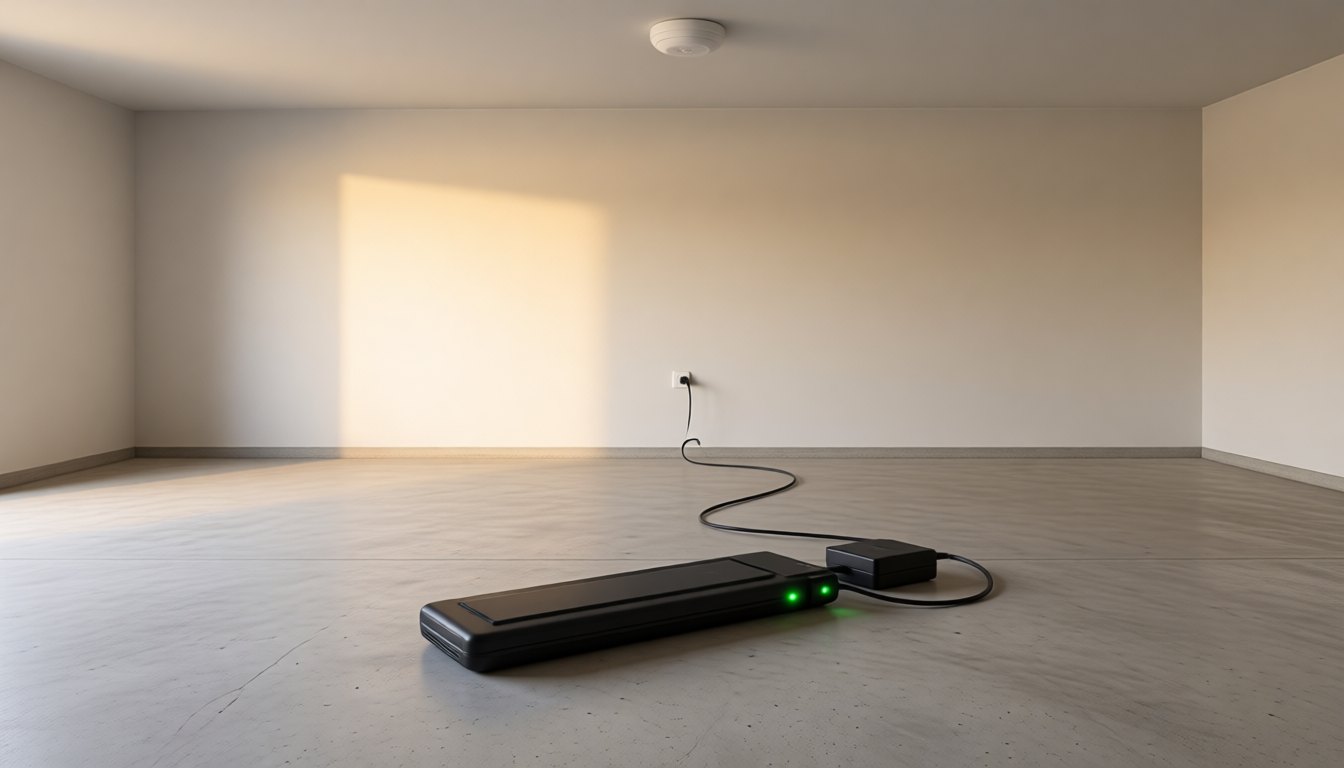
- Charge where you’d notice a problem: while you are home and awake, on a hard surface, away from anything flammable, with a working smoke alarm nearby.
- Never on an escape route. Not in a hallway, under the stairs or by the front door.
- Unplug when it’s full. There is no benefit to leaving it connected.
A note on power: a matched charger is the same whether your battery runs a road-legal kit or not, but the battery voltage often tells you what the bike is for. In the UK, an e-bike is only road-legal as an EAPC: 250W continuous motor power, assistance that cuts out at 15.5 mph, working pedals and a rider aged 14 or over. Higher-voltage packs (52V, 60V, 72V) are often paired with motors above 250W, which are for private land only.
Which Charger Do I Need? Battery → Charger → Product
Here is how our battery families match our chargers. The plug column shows the connector that is typical for that battery family in our range. Always confirm it by looking at the port on your own battery.
| Your battery | Charger voltage | Usual plug | Our charger |
|---|---|---|---|
| 36V downtube | 42V | DC 5.5 × 2.1 mm | Fast charger 42V DC 5.5×2.1mm, approximately £26 |
| 48V downtube (Hailong-style) | 54.6V | DC 5.5 × 2.1 mm | Fast charger 54.6V DC 5.5×2.1mm, 5A, approximately £30 |
| 48V triangle | 54.6V | 3-pin XLR | Fast charger 54.6V 3-pin XLR, 5A, approximately £30 |
| 52V downtube (Hailong-style) | 58.8V | DC 5.5 × 2.1 mm | Fast charger 58.8V DC 5.5×2.1mm, 5A, approximately £30 |
| 52V triangle | 58.8V | 3-pin XLR | Fast charger 58.8V 3-pin XLR, 5A, approximately £30 |
| 60V downtube | 67.2V | DC charging port | We don’t list a separate 67.2V charger. Our 60V battery is listed with a charger in the package. For a replacement, ask us. |
| 72V triangle | 84V | 3-pin XLR | Fast charger 84V 5A 3-pin XLR, approximately £45 (shown as out of stock when we checked, so ask us about availability) |
The 54.6V, 58.8V and 84V chargers are listed as 5A. The 42V charger’s page heading also says 5A, but its description mentions 2A as well, so message us if the exact current matters for your pack.
Buying a new battery? Several of our batteries already include a charger in the box. The 48V 15Ah downtube pack, for instance, ships with a 3A charger. Check the listing in our e-bike batteries range and add a fast charger only if you want it quicker. If you are building a custom pack, the Custom Battery Builder lets you choose the connector and charger along with the voltage and capacity, so they match from day one.
FAQ
What charger do I need for a 48V e-bike battery?
A 54.6V lithium-ion charger with the same plug as your battery’s charging port, usually a 3-pin XLR or a 5.5 × 2.1 mm DC barrel. A 48V lithium-ion pack has 13 cells in series, and 13 × 4.2V = 54.6V when full.
Can I use a 52V (58.8V) charger on a 48V battery?
No. It would push each cell to about 4.52V, well above the safe 4.2V. Only the battery’s BMS would stop it, and if the BMS has failed the pack can overheat, swell or catch fire. Even if the plug fits, don’t use it.
Can I use a 48V (54.6V) charger on a 52V battery?
It won’t overcharge it, but it will only bring the cells to about 3.9V each, so the battery never fills and you lose range. Some BMSs may not charge at all. Use a 58.8V charger.
How long does it take to charge an e-bike battery?
Roughly the battery capacity in Ah divided by the charger current in amps, plus 30 to 60 minutes to finish. A 20Ah battery takes about 4.5 to 5 hours on a 5A charger and about 10.5 to 11 hours on a 2A charger, from flat.
Is a 5A fast charger bad for my battery?
Not if the battery is rated for it. On a 20Ah pack, 5A is a gentle rate. On small packs it works the cells harder, so check the battery’s maximum charge current first, let it cool before charging and never charge below freezing.
What does “3 pin” mean on an electric bike charger?
It normally means a 3-pin XLR plug, the round locking connector that goes into the battery. It does not describe the mains plug. A 3-pin XLR charger only suits batteries with an XLR charging port and the right voltage.
Why does my charger show green but the battery is flat?
Either the charger is faulty or the battery’s BMS has shut the pack down, so the charger sees no load and reports full. Test the battery with a known-good charger of the right voltage. If it still won’t charge, the BMS or cells need checking.
Can I leave my e-bike charging overnight?
We advise against it. Charge while you are home and awake, on a hard surface away from anything flammable, with a smoke alarm nearby, and unplug once it is full.
Lost your charger and not sure what your battery needs? Send George a photo of the battery label and the charging port on WhatsApp, and we’ll tell you which charger fits before you order.