Guides • Conversion Kits • Bafang Mid Drive
Bafang Mid Drive Conversion Kit: Complete UK Guide (BBS01B, BBS02B & BBSHD)
- 1) What is a Bafang mid drive motor?
- 2) BBS01B vs BBS02B vs BBSHD — which is right for you?
- 3) UK law and the 250W EAPC rule
- 4) Frame compatibility: what to check before you buy
- 5) Installation overview
- 6) Choosing the right battery
- 7) DIY vs professional fitting — the honest answer
- 8) Which motor for your use case?
- 9) Get your Bafang fitted in Cardiff
- FAQ
1) What is a Bafang Mid Drive Motor?
A mid drive motor mounts in your bike’s bottom bracket shell — the threaded housing at the base of the frame where the cranks and pedals attach. Unlike a hub motor (which lives inside a wheel), a mid drive sends power through the bike’s existing chain and gears. That matters because it means the motor benefits from your cassette: in a low gear on a steep hill, the motor works less hard to move you the same speed.
The result is better hill climbing, more efficient power delivery, and a ride that feels far more natural than a hub-motor bike, where the power arrives at the wheel regardless of what gear you’re in.
Why Bafang specifically? Bafang is the world’s largest eBike motor manufacturer. Their BBS series has become the de-facto standard for DIY conversion builds because the motors are well-documented, spare parts are globally available, and the programming interface is open — meaning you (or your workshop) can tune power, pedal assist levels, and speed cutoff to suit your exact build and legal requirements.
2) BBS01B vs BBS02B vs BBSHD — Which Is Right for You?
Bafang makes three main mid drive motors for conversion builds. They share the same bottom bracket mounting system and programming interface, but differ significantly in power, torque, and physical size.
| Motor | Rated power | Peak torque | BB shell size | Best for | UK road legal? |
|---|---|---|---|---|---|
| BBS01B | 250W / 350W | ~80 Nm | 68mm / 73mm BSA | City commuting, lighter riders, legal builds | ✓ Yes (250W version) |
| BBS02B | 750W (programmable) | ~120 Nm | 68mm / 73mm BSA | Hilly commutes, heavier riders, trail use | ✓ With correct programming |
| BBSHD | 1000W (programmable) | ~160 Nm | 100mm BSA | Off-road, cargo, e-MTB, demanding builds | ✗ Off-road / private land only |
BBS01B — The Lightweight Commuter
When to choose the BBS01B
- You want a UK road-legal build without any programming complexity — the 250W version complies with EAPC rules out of the box.
- Your route is flat to mildly hilly and you don’t need massive torque.
- Weight matters — the BBS01B is Bafang’s lightest mid drive and puts the least stress on your drivetrain.
- You’re building a commuter or city bike where noise and subtlety matter.
Limitations
- Lower torque ceiling than BBS02B or BBSHD — heavier riders (85kg+) or steep hills will feel the difference.
- Less programmability headroom if your needs change later.
BBS02B — The Most Popular Conversion Motor
Why the BBS02B is the go-to choice
The BBS02B is the motor we fit most often at our Cardiff workshop, and for good reason. It has 50% more torque than the BBS01B, handles sustained climbs on heavy bikes without overheating, and can be programmed to deliver 250W-limited, road-legal assist for public road use. If you’re building a converted commuter or all-around bike in the UK and you’re unsure which motor to choose — this is almost certainly the answer.
- Handles Cardiff’s hills (and South Wales generally) comfortably, even on heavier bikes.
- Same BB shell as the BBS01B — fits any frame that accepts the BBS01B.
- Programmable for road-legal 250W mode or full-power private land use from the same unit.
- Large community, extensive documentation, good parts availability.
BBSHD — For Serious Builds
When the BBSHD makes sense
- Cargo bikes or heavy-duty builds where sustained high torque is required.
- Off-road and e-MTB builds where maximum power delivery matters more than road legality.
- Heavier riders (100kg+) who need a motor that won’t strain under load.
- Builds pairing with a 52V battery — the BBSHD is the BBS motor that benefits most noticeably from the voltage upgrade.
3) UK Law and the 250W EAPC Rule
In the UK, an eBike is legally classed as an Electrically Assisted Pedal Cycle (EAPC) and can be ridden on public roads, cycle paths, and most public land without registration, insurance, tax, or a driving licence — provided it meets all three of these conditions:
| Condition | Requirement | What it means in practice |
|---|---|---|
| Motor power | No more than 250W continuous | The motor’s continuous rated output — not peak. Higher-wattage motors can comply if programmed to limit continuous output to 250W. |
| Assist type | Pedal assist only | The motor must only run while you’re pedalling. Throttle-only operation is not road-legal in the UK for an EAPC. |
| Speed cutoff | Assist must stop above 15.5 mph (25 km/h) | The controller must cut power at this speed — you can still ride faster under your own pedalling power. |
4) Frame Compatibility: What to Check Before You Buy
The BBS series fits a wider range of frames than almost any other mid drive system — but there are still things to check before ordering. Getting this wrong means an expensive return.
The BBS01B and BBS02B require a 68mm or 73mm English-threaded (BSA) bottom bracket shell. This is the standard on the vast majority of steel, aluminium, and titanium road, hybrid, and mountain bikes sold in the UK. The BBSHD requires a 100mm BSA shell.
Press-fit (PF30, BB86, BB92) and threaded non-BSA shells (Italian, BB30) are not directly compatible — adaptors exist but add complexity and are not always ideal. If your bike has a press-fit shell, bring it in and we’ll assess whether an adaptor is appropriate for your build.
The motor unit extends toward the non-drive chainstay. You need at least 6–8mm of clearance between the BB shell face and the chainstay on the motor side. Measure before ordering — very tight frames, especially aggressive MTB geometries, occasionally fall outside this tolerance.
Bafang motors use their own chainring (supplied with the kit — typically 44T, 46T, or 48T). The chain line must align reasonably with your cassette or freewheel. For most 7–9 speed setups this works well with minimal adjustment. 10- and 11-speed drivetrains are tighter and may need more careful attention. We set chain line as part of every professional fitting.
Steel and aluminium frames are generally straightforward. Carbon frames require special care — the motor lock ring must not be over-torqued or you risk damaging the shell. We handle carbon builds at our workshop but they take longer and cost more than standard alloy frames.
You’ll need to run cables for the battery, PAS sensor, brake sensors, and display. External cable routing is simple. Internal cable routing frames need a different approach — if your frame has internal routing, bring it in for assessment before ordering, so you can plan the right cable kit.
5) Installation Overview
The Bafang BBS fitting process is well-documented and genuinely achievable for a confident home mechanic. Here’s the full sequence. For a more detailed step-by-step, see our conversion kit installation guide.
You’ll need a crank puller and a BB removal tool matching your current BB type (cup-and-cone, cartridge, etc.). Threadlock residue on older steel frames should be cleaned out before fitting the new motor.
The motor threads into the BB shell from the drive side. Use the supplied lock ring to secure it from the non-drive side. Apply anti-seize paste on steel frames to prevent corrosion-welding over time. Tighten to the torque spec in the manual — not by feel.
Bafang supplies its own aluminium cranks and chainring. Set the chain line before fully tightening. Check chainring-to-chainstay clearance with the cranks installed at the closest point.
Downtube packs mount to the frame’s existing bottle-cage bosses (M5 at 64mm centres on most frames). Triangle packs sit inside the main frame triangle — measure your triangle carefully against the battery’s dimensions before ordering. Ensure the pack is secure and cannot rattle.
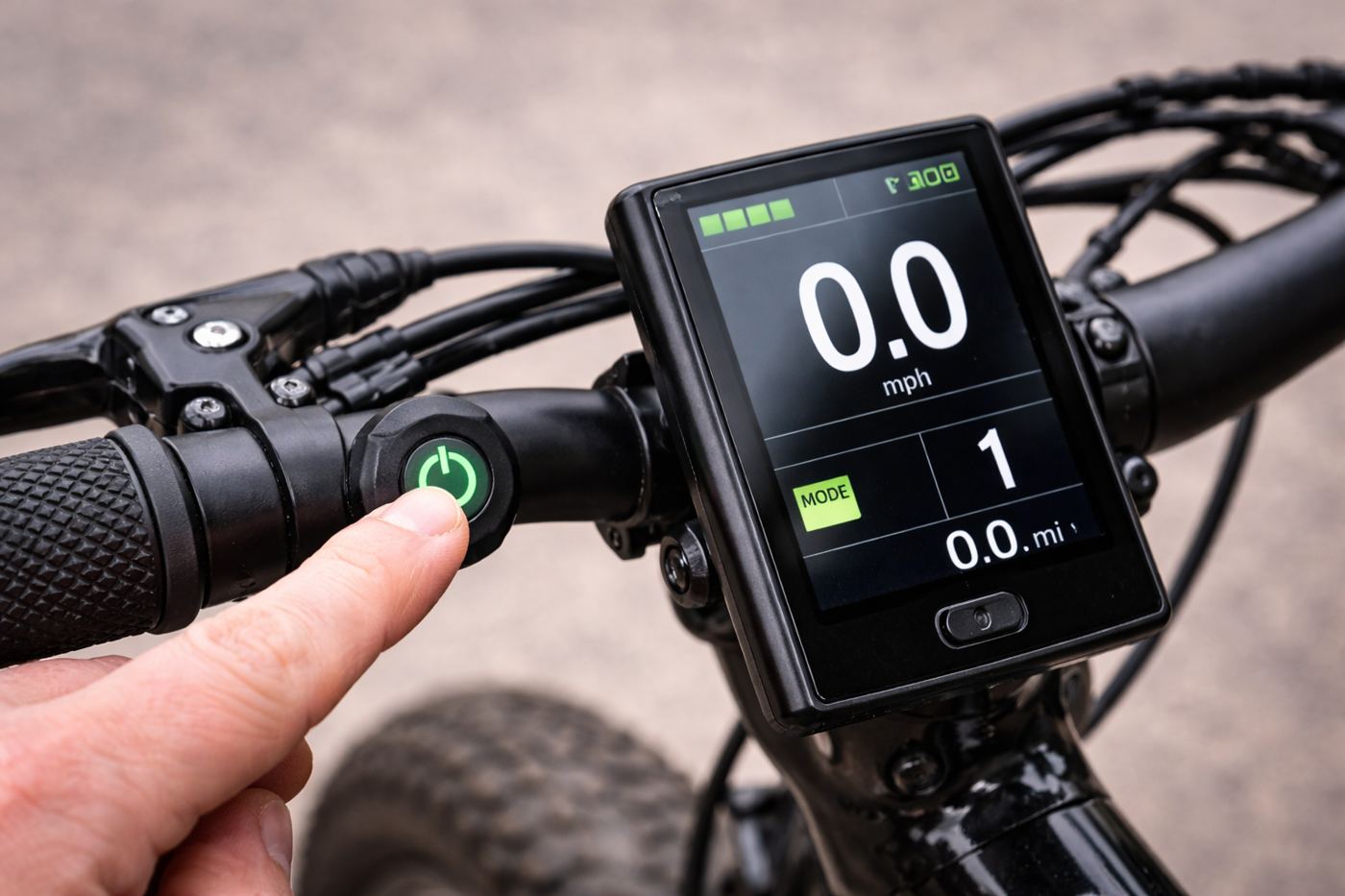
Most builds use the Bafang DPC-18 or SW102 display. Mount on the handlebars, route the cable down to the motor, and fit the PAS sensor to the bottom bracket area (the supplied magnet ring attaches to the crank spider).
Connect: motor to controller (internal), battery to controller, display cable, PAS sensor, brake sensor cut-offs (strongly recommended — they cut motor power when braking). Keep cables tidy and away from the moving drivetrain.
This is the step most DIY builders skip or get wrong. Using the Bafang USB programming cable and PC software, you can set: maximum current (and therefore power), pedal assist levels, speed cutoff, low battery cutoff, and more. For UK road use, set continuous current to deliver no more than 250W and ensure the speed cutoff is at 25 km/h. We do this as standard on every workshop build.
First power-on check: confirm display lights up, PAS responds, brake sensors cut power when levers are pulled. Short test ride to check chain tension, chain line noise, and overall feel. Check all bolts at 50 miles after initial bedding-in.
6) Choosing the Right Battery
The motor and the battery are a system — pairing them correctly makes a real difference to range, power delivery, and component lifespan. Here’s what to match for each Bafang motor.
| Motor | Recommended voltage | Minimum capacity | Typical range | Battery type |
|---|---|---|---|---|
| BBS01B 250W | 36V or 48V | 10Ah (360–480Wh) | 25–45 miles | Downtube |
| BBS02B 750W | 48V (52V for more performance) | 13Ah (624Wh) | 30–55 miles | Downtube or triangle |
| BBSHD 1000W | 48V or 52V | 17.5Ah (840Wh+) | 35–60 miles | Triangle (preferred) |
Mounts to bottle-cage bosses on the downtube. Easy to remove for indoor charging. Best for builds where quick battery removal is useful or where frame triangle space is limited.
Browse 48V downtube batteries →
Browse 52V downtube batteries →
Sits inside the main frame triangle. Better weight distribution, higher capacity options, and a cleaner look. Preferred for BBSHD builds and heavier builds where centre-of-mass matters.
Browse 48V triangle batteries →
Browse 52V triangle batteries →
Use our eBike performance calculator to estimate range for your specific weight, terrain, and assist level.
7) DIY vs Professional Fitting — The Honest Answer
Bafang BBS kits are among the most DIY-friendly mid drive systems available. The fitting process is well-documented, the required tools are standard, and the community is large. If you’re comfortable with basic bicycle maintenance, a BBS01B or BBS02B installation is achievable at home.
That said, professional fitting makes sense in a number of situations:
- You have a standard 68mm BSA frame with external cable routing.
- You’re comfortable with bicycle tools and have done BB work before.
- You have time to research and troubleshoot the programming step.
- You’re building an off-road or private-land bike where road legality programming is less critical.
- You want the motor correctly programmed for UK road legality.
- Your frame is carbon, has internal cable routing, or a non-standard BB shell.
- You’re fitting a BBSHD — the larger motor and 100mm shell demand more experience.
- You rely on the bike daily and can’t afford downtime from a mistake.
- You want a post-fit check and road test included.
8) Which Motor for Your Use Case?
Recommended: BBS01B 250W + 48V 10–13Ah downtube battery
Quiet, lightweight, fully road-legal, and perfectly suited to city riding. The 250W version requires no programming for EAPC compliance.
Recommended: BBS02B + 48V 15Ah downtube or triangle battery
The BBS02B’s 120 Nm of torque handles sustained South Wales gradients without overheating. Programmed to 250W for road use. The 15Ah pack gives enough range for a full day without range anxiety.
Recommended: BBS02B or BBSHD + 52V 17.5Ah triangle battery
A triangle pack keeps weight centred for better handling off-road. 52V is worth the upgrade here — the BBSHD in particular benefits from the voltage headroom on sustained climbs. Aim for 850Wh+ for a full day out.
Recommended: BBSHD + 48V or 52V 20Ah triangle battery
The BBSHD’s 160 Nm of torque is the right tool for cargo loads and persistent heavy-duty use. Verify your frame has a 100mm BSA shell before ordering.
Check the label on your existing controller for its input voltage range. If the motor model is unknown, send us a photo on WhatsApp and we’ll identify it. We also offer a compatibility check and consultation at our Cardiff workshop.
9) Get Your Bafang Fitted in Cardiff
We’re Cardiff’s dedicated eBike conversion workshop, based in Roath (CF24). We supply and fit the full Bafang BBS range — BBS01B, BBS02B, and BBSHD — with full in-house controller programming, chain line setup, and a road test before handover.
Motor, battery, display, cable routing, and programming — all completed in our Roath workshop. Every road build leaves configured to 250W EAPC spec.
Prefer to DIY? We supply BBS kits with UK next-day delivery available. Ask us on WhatsApp to confirm compatibility with your frame before ordering.
Already have a Bafang and need it reprogrammed, repaired, or upgraded to a bigger battery? We handle those too — see our service menu.
Visit us: 2 Beresford Road Lane, Cardiff, CF24 1QU
Hours: Mon–Fri 11am–6pm • Sat 11am–3pm • Sun closed
Shop Bafang Kits
Browse Batteries
Workshop Services
Cardiff eBike Repair
FAQ
Yes — when programmed correctly. The BBS02B must be configured to deliver no more than 250W continuous assist, assist only when pedalling, and cut off above 15.5 mph (25 km/h). A 750W-rated motor can legally run in 250W mode. We configure all road-use builds to EAPC spec at our Cardiff workshop as standard.
The BBS01B and BBS02B require a 68mm or 73mm threaded English (BSA) bottom bracket shell — the standard on most UK bikes. The BBSHD requires a 100mm BSA shell. Press-fit and PF30 shells need specialist adaptors and are not always ideal. Measure before ordering.
A BBS02B kit with battery typically costs £350–£500 depending on battery capacity. Professional fitting at our Cardiff workshop is charged separately — contact us for current pricing. A complete installed BBS02B build with a 48V 15Ah battery is usually in the range of £600–£800 all-in.
Yes, but it requires more care than steel or aluminium. Carbon BB shells can crack if the motor lock ring is over-torqued. We handle carbon builds at our Cardiff workshop — we do not recommend DIY installation on carbon frames.
Yes — this is an honest trade-off with any mid drive system. Because the motor drives through the chain, component wear is higher than with a hub motor. Using a quality chain, a reinforced chainring (Bafang’s steel option is better for this than the standard aluminium one), and changing your chain regularly at 0.5% stretch rather than waiting for 0.75% significantly extends drivetrain life. We stock eBike-specific drivetrain parts.
Yes — Bafang controllers support a thumb or twist throttle. For UK public road use, a throttle must not move the bike without pedalling to remain EAPC-compliant. Many riders fit one for walking assist or private land use. We can discuss the right configuration for your intended use.
Still have questions about your specific frame or build? Message us on WhatsApp with your frame details, current bike spec, and how you intend to use it — we’ll give you a straight answer and a recommendation from our UK stock.
© All4eBikes • Educational content for e-bike builders and riders.