Guides • Batteries • Buying Advice
Which E-Bike Battery Do I Need? 36V vs 48V vs 52V vs 72V Explained
Published: June 4, 2026 • Reading time: ~20–25 min • All4eBikes, Cardiff
Battery guide
36V / 48V / 52V / 72V
Bafang compatible
Hub motor
Range & capacity
UK stock
Quick answer: For most UK conversion builds using a Bafang mid-drive or standard hub motor, a 48V battery is the right starting point — it’s the most widely compatible voltage, well-supported by controllers, and available in the widest range of capacities. If you’re building something more powerful or want maximum performance from a 750W–1000W+ system, 52V is the next step up. 36V suits lighter, legal-compliant 250W builds. 72V is for high-power private-land builds only.
1) The Basics: Voltage, Ah, Wh — What They Actually Mean
Battery specs look intimidating, but there are really only three numbers you need to understand before buying. Everything else follows from these.
| Term |
What it means |
Analogy |
Why it matters |
| Voltage (V) |
The electrical “pressure” of the system |
Water pressure in a pipe |
Must match your motor and controller. Higher V = same power at lower current = less heat in wiring. |
| Capacity (Ah) |
How much charge the battery holds |
The size of the water tank |
More Ah = longer range, more weight, higher cost. |
| Energy (Wh) |
The total usable energy: V × Ah = Wh |
Total water volume available |
The single best number for comparing range across different batteries. |
Example: A 48V 15Ah battery contains 720Wh of energy. A 36V 20Ah battery contains 720Wh too. Same total energy — but the 48V system runs at higher pressure, which suits higher-power motors better and keeps wiring cooler.
What is voltage sag — and why does it matter?
Under heavy load (steep climb, full throttle, cold morning), battery voltage drops temporarily below its nominal rating. A good battery with a properly rated BMS (Battery Management System) recovers quickly when load eases. A cheap or underpowered pack sags badly — your motor loses power exactly when you need it most. This is one of the key reasons to buy a quality pack, not just the cheapest option.
Fully charged vs nominal voltage: A “48V” battery is actually around 54.6V when fully charged and cuts off around 39–42V when depleted. “48V” refers to the nominal (average working) voltage. This is normal — it applies to all lithium systems.
2) The Four Main Voltages Explained
36V
36V — The Lightweight, Legal-Build Choice
Nominal voltage36V (charged: ~42V)
Typical capacity range10Ah – 20Ah (360–720Wh)
Best motor match250W motors, light hub builds
UK road legalityCompatible with 250W road-legal setups
Typical build typeCommuter, light city bike, legal pedelec
When to choose 36V
- You’re running a 250W motor and want to stay UK road-legal.
- Weight is a priority — 36V packs tend to be lighter for the same Ah rating.
- You’re building a lightweight commuter or folding bike where a compact battery matters.
- Your existing controller or motor is rated for 36V and you don’t want to change it.
Limitations of 36V
- Lower power ceiling — not suited to motors above 350W.
- More current required to deliver the same wattage as a 48V system, meaning more heat in wiring and connectors.
- Less headroom for hill climbing on heavier builds.
48V
48V — The Universal Standard (Most Builds Start Here)
Nominal voltage48V (charged: ~54.6V)
Typical capacity range10Ah – 30Ah (480–1440Wh)
Best motor match250W–1000W motors, Bafang BBS series, hub motors
UK road legalityCompatible with 250W road-legal setups; higher wattage for private land
Typical build typeCommuter, trail, cargo, all-around conversion
Why 48V is the default choice
48V is the sweet spot of the e-bike world. It’s supported by the vast majority of controllers, motors, and chargers. The Bafang BBS01B, BBS02B, and BBSHD all run on 48V natively (the BBSHD also takes 52V). Nearly every off-the-shelf hub motor kit in our range supports 48V.
- Wide compatibility: works with almost every motor and controller on the market.
- Efficient wiring: higher voltage than 36V means less current for the same power, reducing heat.
- Best parts availability: widest range of battery shapes, sizes, and capacities.
- Good hill performance: with a 10Ah+ pack and appropriate motor, handles UK hills confidently.
When 48V might not be enough
- You’re running sustained high power (750W+) and seeing significant voltage sag on climbs.
- You want more top-end speed or snappier power delivery from the same motor.
- You’re pushing a high-current controller and want to reduce thermal stress.
52V
52V — The Performance Upgrade (Same Motors, More Power)
Nominal voltage52V (charged: ~58.8V)
Typical capacity range10Ah – 25Ah (520–1300Wh)
Best motor matchBafang BBSHD, BBS02B (52V rated), 500W–1000W hub motors
UK road legalityFor private land / higher-power builds; 250W mode still possible
Typical build typeTrail, mountain, high-performance conversion
Why choose 52V over 48V?
A 52V battery is essentially a “hot-rodded” 48V system. The cells are arranged to give approximately 8–10% more voltage, which translates directly into more power from the same motor and controller — without needing to change anything else (provided your motor and controller are 52V-rated).
- More power, same motor: the Bafang BBSHD is 48V/52V compatible — running it on 52V gives noticeably stronger acceleration and better hill performance.
- Less sag under load: the higher starting voltage means voltage under load stays higher, so the motor runs stronger through demanding sections.
- Better thermal management: same power at higher voltage = lower current = less heat in motor windings and wiring.
52V compatibility check — do this before buying
⚠️ Not all 48V motors and controllers accept 52V. Check your motor and controller’s maximum input voltage before switching. Many 48V controllers have MOSFETs rated to 60V, which gives headroom for 52V (charged to 58.8V) — but not all do. When in doubt,
message us on WhatsApp with your motor model and we’ll confirm compatibility.
72V
72V — High Power, Private Land Only
Nominal voltage72V (charged: ~84V)
Typical capacity range20Ah – 40Ah (1440–2880Wh)
Best motor match1500W–5000W hub motors, dedicated high-power mid-drives
UK road legalityNot road legal — private land use only
Typical build typeHigh-power off-road, enduro, cargo, custom builds
When 72V makes sense
- You’re running a 2000W+ motor and need serious power delivery without thermal stress.
- Private land or off-road use only — no public road riding.
- Cargo builds or heavy loads requiring sustained high-torque performance.
- You’re building a high-power custom bike and understand the electrical and safety implications.
What changes at 72V
- Your entire electrical system — motor, controller, charger, display, and BMS — must be 72V-rated. You cannot mix 48V or 52V components.
- Higher voltage means higher energy stored, which demands more rigorous fusing, wiring quality, and connector sizing.
- Packs are heavier and larger; mounting and securing them on a bike requires careful planning.
⚠️ Safety note: 72V systems carry significantly higher energy than lower voltages. Fusing, quality connectors, and a well-specced BMS are non-negotiable. If you’re new to high-voltage builds, we strongly recommend
bringing your build to our Cardiff shop for a professional check before first ride.
3) How Much Capacity Do You Need? (Ah, Wh, and Range)
Once you’ve chosen your voltage, the next decision is capacity. More capacity means more range and more weight. Here’s how to think about it.
The Wh calculation
Always compare batteries in Wh (watt-hours), not Ah alone. A 48V 10Ah battery has 480Wh. A 36V 15Ah battery has 540Wh. The second one has more range even though it has the same Ah as a hypothetical 36V 10Ah pack with less energy.
| Voltage |
Capacity |
Total energy |
Typical use case |
| 36V |
10Ah |
360Wh |
Short commutes (10–20 miles), light assist |
| 48V |
10Ah |
480Wh |
City commuter, moderate assist (15–25 miles) |
| 48V |
15Ah |
720Wh |
All-day commuter, light trail riding (25–40 miles) |
| 48V |
20Ah |
960Wh |
Long days, cargo, hilly routes (35–55 miles) |
| 52V |
17.5Ah |
910Wh |
Trail riding, mountain builds (35–50 miles) |
| 60V |
20Ah |
1200Wh |
High-power builds, long off-road rides |
| 72V |
27Ah |
1944Wh |
Max range, heavy cargo, high-power off-road |
Rule of thumb: Budget roughly 15–25Wh per mile for typical UK riding with moderate assist on a mid-drive build. Heavier riders, steeper terrain, full throttle, or cold weather all push consumption higher. When in doubt, size up — a bigger battery weighs a little more but gives you the headroom to enjoy riding without anxiety.
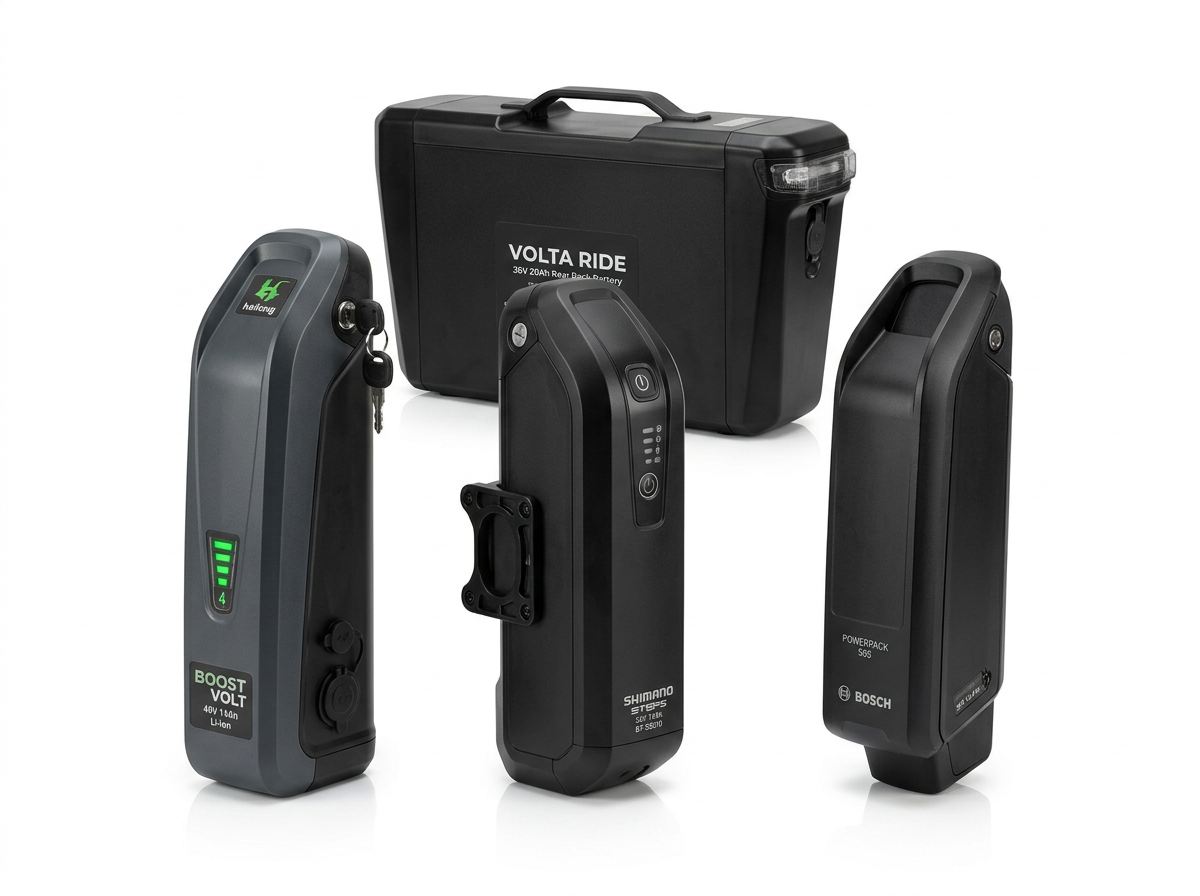
4) Battery Types: Downtube vs Triangle
Beyond voltage and capacity, you need to choose a battery form factor that physically fits your bike.
Downtube battery
Mounts to the downtube of the frame using standard bottle-cage bolt holes (typically 2× M5 bolts on 64mm centres). The most common format for conversion builds.
Pros: Easy to fit on most frames, easy to remove for charging, low centre of gravity.
Cons: Limited by downtube length; capacity ceiling roughly 20–25Ah at 48V before packs get unwieldy.
Browse 48V downtube batteries →
Browse 52V downtube batteries →
Triangle battery
Fits inside the main triangle of the frame — the area between the top tube, downtube, and seat tube. Gives a lower, more centred weight distribution.
Pros: Better weight distribution, higher capacity possible, cleaner look, more protected from knocks.
Cons: Requires measuring your frame triangle carefully; not all frame sizes accommodate all pack sizes; less easy to remove quickly.
Browse 48V triangle batteries →
Browse 52V triangle batteries →
How to measure your frame for a triangle battery
- Effective top tube length — measure the horizontal distance from head tube to seat tube.
- Seat tube length (above BB) — from bottom bracket to where the seat tube meets the top tube.
- Downtube clearance — ensure the pack won’t foul the front derailleur or cable routing.
- Bottom bracket clearance — check the pack doesn’t contact the chainring or crank arms.
What about 60V batteries?
60V sits between 52V and 72V — it’s a less common but useful voltage for builds that need more power than 52V but where the full complexity of a 72V system isn’t needed. We stock 60V downtube batteries for compatible builds. Check your motor and controller’s maximum voltage rating before considering 60V.
5) Compatibility: Which Battery Works With Your Motor?
Battery voltage must match your motor and controller. This is non-negotiable — running a battery at a voltage higher than your controller’s rated input can destroy it. Here’s a quick reference for the most common motor systems we stock and install.
| Motor / kit |
Supported voltages |
Recommended battery |
Notes |
| Bafang BBS01B 250W |
36V, 48V |
48V 10–15Ah downtube |
48V gives marginally better performance; 36V fine for strict road-legal builds |
| Bafang BBS02B 750W |
36V, 48V |
48V 15–20Ah downtube or triangle |
48V strongly recommended; 36V undersells the motor’s capability |
| Bafang BBSHD 1000W |
48V, 52V |
48V 17.5–20Ah or 52V 17.5Ah triangle |
52V noticeably improves performance; BBSHD is the best Bafang to run on 52V |
| Rear hub motor 36V 250W |
36V |
36V 10–15Ah downtube |
Designed for 36V; do not exceed rated voltage |
| Rear hub motor 36V/48V 500W |
36V, 48V |
48V 12–17.5Ah downtube or triangle |
48V gives noticeably better hill performance |
| Rear hub motor 48V/52V 1000W |
48V, 52V |
48V 17.5–20Ah or 52V 17.5Ah triangle |
52V gives strongest hill and acceleration performance |
Not sure about your motor? Check the label on the controller (usually mounted near the motor) — it will show the input voltage range (e.g. “Input: 36V–52V DC”). That’s the safe operating range for your battery.
6) Discharge Rate: Why It Matters More Than Most People Think
A battery’s capacity (Wh) tells you about range. Its continuous discharge rating tells you whether it can deliver power reliably under load without overheating, sagging badly, or triggering the BMS protection cutoff.
Understanding the C-rating
- The discharge rating is often expressed as a C-rate — a multiplier of the battery’s Ah capacity.
- A 10Ah battery at 1C can deliver 10A continuously. At 2C, it can deliver 20A.
- Most e-bike controllers draw 15–30A at peak demand (hill, full throttle).
| Build type |
Typical peak current draw |
Minimum recommended discharge |
| 250W road-legal commuter |
7–10A |
10A continuous (1C on a 10Ah pack) |
| 500W–750W all-around build |
15–20A |
20A continuous (BMS rated to 20A+) |
| 1000W mid-drive or hub |
25–35A |
30A+ continuous; 40A+ peak |
| High-power 2000W+ build |
40–60A+ |
50A+ continuous; 80–100A peak BMS |
⚠️ Cheap batteries often over-claim discharge ratings. A pack advertised as “30A continuous” that actually delivers 15A before the BMS trips will perform poorly on hills and may degrade faster. All batteries we stock are specified honestly — if you have questions about a specific pack’s discharge capability for your motor,
ask us before you order.
7) Real-World Range Guide for UK Riding
Range estimates on battery listings tend to be optimistic — they assume flat roads, light riders, and minimal assist. Here’s a more realistic guide based on typical UK conditions.
| Riding type |
Approx Wh/mile |
Range from 480Wh (48V 10Ah) |
Range from 720Wh (48V 15Ah) |
Range from 960Wh (48V 20Ah) |
| Flat commute, light assist (eco mode) |
10–15 Wh/mile |
32–48 miles |
48–72 miles |
64–96 miles |
| Mixed terrain, moderate assist |
15–22 Wh/mile |
22–32 miles |
33–48 miles |
44–64 miles |
| Hilly UK roads (Cardiff, South Wales, etc.) |
20–30 Wh/mile |
16–24 miles |
24–36 miles |
32–48 miles |
| Mountain trails, high assist / throttle |
25–40 Wh/mile |
12–20 miles |
18–29 miles |
24–38 miles |
Factors that reduce range significantly:
- Cold weather (below 5°C can reduce range by 15–30%)
- Rider + cargo weight above 90kg
- Persistent headwinds
- Knobby off-road tyres on tarmac
- Using throttle instead of pedal assist
- Running at maximum assist constantly
8) How to Choose: A Decision Guide by Use Case
Use case 1 — Daily commuter, flat-ish UK city riding
Recommended: 48V 10–15Ah downtube battery (~480–720Wh).
This covers most UK daily commutes with range to spare. A downtube pack is easy to remove and charge indoors. Pair with a 250W Bafang or a 500W hub motor for a quiet, efficient setup.
Browse 48V downtube batteries →
Use case 2 — Hilly commute or South Wales terrain
Recommended: 48V 15–20Ah downtube or triangle battery (~720–960Wh).
Hills eat range. A 15Ah minimum gives comfortable margins. A Bafang BBS02B at 48V handles sustained South Wales gradients well without overheating.
Browse 48V triangle batteries →
Use case 3 — Trail riding and off-road MTB conversion
Recommended: 48V 17.5–20Ah triangle or 52V 17.5Ah triangle (~840–960Wh).
Triangle packs keep weight centred and low. 52V is worth considering here — the BBSHD in particular benefits noticeably from the voltage headroom on sustained climbs. Aim for 850Wh+ for a full day out.
Browse 52V triangle batteries →
Use case 4 — High-power build (1000W+, private land only)
Recommended: 52V 20Ah triangle or 72V 20Ah+ triangle depending on motor rating.
For 1000W mid-drives (BBSHD), 52V is often the right ceiling. For 2000W+ hub motors, 72V gives the voltage headroom to deliver power without over-stressing the battery.
Browse 72V triangle batteries →
Use case 5 — Not sure what you have / upgrading an existing build
Check the label on your controller or motor casing for the rated input voltage. Match your new battery to that voltage exactly (within the stated range). If the label is missing or unreadable, message us on WhatsApp with the motor model and we’ll identify it. We also offer battery diagnostics at our Cardiff shop if you’re unsure whether your existing pack is still healthy.
9) Battery Safety, Storage and Care
Lithium batteries are safe when treated correctly — the overwhelming majority of problems come from physical damage, poor charging habits, or very cheap cells with no real BMS protection.
Charging best practice
- Use only the charger supplied or specified for your battery — wrong charger = wrong cutoff voltage.
- Charge indoors at room temperature when possible (5–25°C ideal).
- Don’t leave on charge unattended for extended periods after full.
- For long-term storage (weeks+), store at around 50–60% charge, not full and not empty.
- Never charge a visibly damaged, swelling, or hot pack.
Mounting and handling
- Secure the pack firmly — vibration loosens contacts and stresses the casing.
- Protect from direct rock strikes with a downtube guard (especially off-road).
- Keep connector faces clean and dry; use dielectric grease on waterproof connectors.
- After a fall, inspect the pack for dents, cracks, or deformation before using.
- Fuse the battery positive lead close to the battery — a cheap inline fuse is cheap insurance.
⚠️ Signs a battery needs replacing or professional inspection: visibly swelling cells, burning smell during charge, significant voltage drop when first loaded (more than 5–6V below nominal), repeated BMS cutout under moderate load, or a pack that no longer charges to full. Bring it to our
Cardiff battery repair and diagnostics service.
FAQ
Can I use a 52V battery on my 48V motor?
Only if your motor and controller are rated for 52V input. Many 48V controllers use MOSFETs rated to 60V and will accept 52V (max charge voltage ~58.8V). However, always verify your controller’s specification before trying. Running a battery at above-rated voltage can damage or destroy the controller and may pose a safety risk.
Does a higher voltage battery mean faster speed?
For a given motor winding, yes — higher voltage increases the motor’s no-load RPM (and thus top speed). However, most road-legal UK builds have a speed limit enforced by the controller regardless of voltage. On private land builds, higher voltage can increase top speed as well as power.
How do I know if my battery’s BMS is adequate?
Look for the BMS continuous current rating (often printed on the pack label or available from the supplier). It should be equal to or greater than the continuous current your controller draws. If in doubt,
ask us — we’ll match you to a battery whose BMS is correctly rated for your motor.
What’s the difference between a 48V 10Ah and a 48V 15Ah battery beyond range?
A larger pack doesn’t just give more range — it also typically handles peak current demands better because the same current represents a lower C-rate draw. This means less voltage sag on hills and a longer cycle life (more charge cycles before significant capacity loss).
My battery shows the right voltage but the range seems very short — why?
Likely causes: cells have degraded (common after 500+ full cycles or abuse), BMS is cutting capacity to protect weak cells, or the pack was never the capacity claimed. We offer
battery diagnostics at our Cardiff shop — we can test your pack’s real capacity and advise on whether a repair or replacement makes more sense.
Can I carry a spare battery to double my range?
Yes — this is a popular option for long rides. Carry the spare in a bag and swap at a convenient stop. Just make sure both batteries are the same voltage and the connectors match (or use an appropriate adapter). Keep the spare at around 50% charge during transport and store it away from heat and puncture risk.
Still not sure which battery is right for your build? Message us on WhatsApp with your motor model, controller details, frame type, and typical riding terrain — we’ll recommend the right battery from our UK stock and get it to you next day.
© All4eBikes • Educational content for e-bike builders and riders.