Spend £600, Save £20
Spend £1000, Save £40
Spend £300, Save £10
UK Stock, next day delivery available!
Shopping Cart
No products in the cart.

DIY Guides • Conversion Kits • Bafang BBSHD

Bafang BBSHD Installation Guide UK: Complete Step-by-Step Walkthrough

Published: June 22, 2026  •  Reading time: ~20 min  •  All4eBikes, Cardiff

Bafang BBSHD
Mid drive installation
Bottom bracket
UK road legal
1000W conversion
Cardiff workshop
Before you start: The BBSHD requires a 100mm or 120mm BSA threaded bottom bracket shell — not the standard 68mm/73mm found on most road and hybrid bikes. Confirm your BB shell width before ordering the motor. If you’re unsure, bring your frame to our Cardiff workshop and we’ll measure it for you.

1) BBSHD vs BBS02B — Which Should You Choose?

The BBSHD sits above the BBS02B in Bafang’s mid-drive range. It is larger, heavier, and requires a wider bottom bracket shell — but delivers substantially more torque and handles sustained high-load conditions the BBS02B struggles with. Before committing to a BBSHD build, confirm it is the right tool for your application.

Specification BBS01B BBS02B BBSHD
Nominal power 250W 750W 1,000W
Peak torque ~80 Nm ~120 Nm ~160 Nm
BB shell required 68mm / 73mm BSA 68mm / 73mm BSA 100mm / 120mm BSA
Motor weight ~2.45 kg ~2.9 kg ~3.9 kg
Controller current (stock) 15A 25A 30A
UK road legal? ✓ Yes (250W version) ✓ When programmed ✓ When programmed
Best for Road commuter All-rounder, hilly commutes Fat bike, cargo, e-MTB, high-load off-road
UK law note: The BBSHD can be programmed to meet UK EAPC rules — 250W continuous assist, pedal assist only, 25 km/h speed cutoff. In that configuration it is fully road-legal on public roads. Un-programmed from the factory, or if de-restricted beyond these limits, it is off-road and private-land use only. We program every road-use BBSHD build to EAPC spec at our Cardiff workshop as standard.

The BBSHD makes most sense for: fat bikes and plus-tyre builds (100mm BB is common on these), cargo bikes and heavy-load riders, high-power off-road e-MTB builds, and any application where the BBS02B has proven thermally limited on long sustained climbs. If your frame has a standard 68mm BB and you want a road-legal commuter, the BBS02B is almost certainly the better fit.

2) Frame Compatibility & BB Shell Check

Frame compatibility is the single most common point of failure in a BBSHD build. Measure before you order — not after.

BB shell width

The BBSHD motor sleeve has an external diameter of 33.4mm and requires a BB shell with a 33.6mm internal bore (standard BSA/English thread). The motor comes in two widths:

100mm BBSHD
Fits 100mm BSA shells. Standard on most fat bikes. Can fit 68mm/73mm shells with spacers — but we advise against this on aluminium frames due to the higher torque loads involved.
120mm BBSHD
Fits 120mm BSA shells. Common on wider fat bikes and cargo frames. Too wide for standard mountain bike shells without extensive shimming.

To measure your BB shell: remove the existing bottom bracket, clean the shell, and measure the internal width between the left and right faces with a vernier calliper. If in doubt, bring your frame to the workshop and we will measure it for you at no charge.

Chainstay clearance

The BBSHD has a larger secondary reduction gear housing than the BBS02B, which protrudes further on the chain side. On some frames — particularly those with aggressive chainstay shapes — this housing will contact the chainstay and prevent the motor seating correctly.

The test: dry-fit the motor in the BB shell without tightening the lock ring. Check the gap between the secondary gear housing and the nearest chainstay face. You need a minimum of 2–3mm clearance on all sides. If there is contact, the build needs further assessment before proceeding.

⚠️ Carbon frames: The BBSHD inner lock ring must be torqued to 50 Nm. Carbon BB shells can crack or delaminate at this torque if the shell layup is insufficient. We handle carbon BBSHD builds at our Cardiff workshop and do not recommend DIY installation on carbon. Bring it to us.

BB shell thread standard

The BBSHD requires a BSA (English/ISO) threaded shell — right side right-hand thread, left side left-hand thread. It is not compatible with Italian threaded shells, PF30, BB86, BB92, or BB386 press-fit shells without adaptors. Press-fit adaptors for the BBSHD’s wider body are not reliable — we do not recommend them.

3) Kit Contents & Tools You Need

What’s in the BBSHD box

Motor and drive components

  • BBSHD motor unit
  • Main wiring harness
  • Left and right crank arms
  • Crank arm bolts (x2)
  • M33 steel inner lock ring
  • M33 aluminium outer lock ring
  • Retaining bracket + M6 bolts (x2)
  • Chainring (44T or 46T)
  • Chainring bolts
  • Basic BB wrench (functional but limited — replace for serious work)
Electronics and controls

  • Speed sensor + magnet
  • PAS disc + sensor unit
  • Display (500C, 750C, 860C, or DPC18 depending on kit)
  • Display mount / handlebar clamp
  • Auxiliary control pad
  • Throttle (thumb or half-twist)
  • Brake cut-off sensors (x2)

Tools required

Mechanical

  • Crank puller (matched to your crank type)
  • BB removal tool (matched to your existing BB)
  • Bafang M33 socket set — 4-notch inner + 16-notch outer
  • Torque wrench, ½” drive (0–60 Nm range)
  • Torque wrench, ⅜” drive (1–25 Nm range)
  • 5mm and 6mm hex keys
  • T20 Torx security bit
  • Rubber mallet
  • Vernier calliper
Consumables and finishing

  • Anti-seize grease (for BB shell threads)
  • Medium-strength thread-locking compound (e.g. Loctite 243) for chainring bolts
  • Cable ties (zip ties, various sizes)
  • Cable cutter / side cutters
  • Needle-nose pliers
  • Chain tool (to size the chain)
  • Chain wear indicator
The M33 socket set is the most important tool on this list. The included BB wrench will not give you an accurate 50 Nm torque — and under-tightening is the number one cause of a loose, rotating motor. Buy or borrow a proper socket set before starting.

4) Stage 1 — BB Shell Preparation

Step 1 — Remove the existing cranks

Use a crank puller matched to your crank type. Loosen the crank bolt first (usually 8mm hex), thread the puller body into the crank, then advance the centre spindle until the crank pops free. Do both sides. If you have Shimano Hollowtech or similar bonded cranks, use the appropriate splined tool.

Step 2 — Remove the existing bottom bracket

Identify your BB type and use the correct splined or pin-type removal tool. On a BSA shell: the right-side cup is left-hand thread (loosens clockwise); the left-side cup is right-hand thread (loosens anticlockwise). Apply penetrating oil and wait 20 minutes if the BB has been in place for years. Seized BBs are extremely common on bikes that have seen wet UK winters — do not force it without penetrating oil.

Step 3 — Clean and inspect the shell

Wire-brush or clean all thread surfaces. Remove old grease, grit, and any thread-locking compound residue. Inspect carefully for damaged or stripped threads — the motor’s M33 lock rings need clean threads to torque properly. Damaged threads should be re-chased with a tap by a bike shop before proceeding. A stripped BB shell is not a minor issue — it requires frame repair or replacement.

Step 4 — Face the shell if needed

On most production frames the two shell faces are parallel and smooth. On older or budget frames they can be slightly uneven, causing the motor to sit at an angle. If the dry-fitted motor rocks or won’t sit flush, have the shell faced at a bike shop before continuing. A faced shell costs far less than diagnosing a noisy motor later.

Step 5 — Apply anti-seize to the shell threads

Apply a thin, even coat of anti-seize compound to the internal shell threads. This prevents galvanic corrosion between the shell and the lock rings, and ensures the motor can be removed in future without damaging the shell. Do not use thread-locking compound inside the shell — the lock rings must remain removable for maintenance.

5) Stage 2 — Seating and Securing the Motor

Step 1 — Insert the motor from the chain side

Hold the motor with the output shaft pointing toward the right (chain side) of the frame. Lower the motor sleeve into the BB shell from the right. The sleeve OD is 33.4mm and the shell ID is 33.6mm — it should slide in with light resistance. Do not force it. If it binds, remove and check for thread burrs. Before seating fully, rotate the motor in the shell to plan the harness connector port position — ideally pointing upward or slightly forward for clean cable routing.

Step 2 — Fit the retaining bracket

Slide the metal retaining bracket onto the left side of the motor sleeve, with the radial ridges facing the BB shell edge. Thread the two M6 bolts finger-tight only at this stage — final tighten comes after the lock rings are torqued. The bracket stops the motor rotating in the shell under load.

Step 3 — Torque the M33 inner (steel) lock ring

The inner grey steel lock ring has 4 notches and threads onto the motor sleeve from the left, clockwise. Thread it finger-tight. Then fit the M33 4-notch socket and torque wrench and tighten to 50 Nm. This is the single most critical fastener on the entire installation. Under-tightening causes the motor to work loose and strip the BB shell threads — a failure that can write off the frame.

Step 4 — Torque the M33 outer (aluminium) lock ring

The outer black aluminium lock ring threads on outside the inner ring. Use the 16-notch socket. Torque to 25 Nm — lower than the inner because it is aluminium and will strip if over-tightened.

Step 5 — Final-tighten the retaining bracket

With both lock rings torqued, final-tighten the retaining bracket bolts to 10 Nm. Hold the bracket pressed upward against the shell edge while tightening — the radial ridges need to bite into the shell to resist motor rotation effectively.

Step 6 — Chainstay clearance check

With the motor secured, physically check the gap between the secondary reduction gear housing and the chainstay on the chain side. Run your fingers all the way around the housing. There must be clear daylight on all sides. Any contact needs addressing before wiring begins.

Torque reference summary:
Inner steel lock ring → 50 Nm
Outer aluminium lock ring → 25 Nm
Retaining bracket bolts → 10 Nm
No thread-locking compound on lock rings — they must remain removable.

6) Stage 3 — Chainring and Crank Installation

Step 1 — Select your chainring

The BBSHD uses a proprietary spider with a 104mm BCD bolt pattern. The included chainring is typically 44T or 46T. For off-road builds with wide-range cassettes, many builders drop to 42T or 38T for better mechanical advantage on climbs. Avoid 52T or larger — at BBSHD power levels these stress the chain aggressively. Steel chainrings outlast aluminium by a significant margin under motor load — fit a steel option if you are building for serious mileage.

Step 2 — Fit the chainring and check chainline

Mount the chainring on the spider with Loctite 243 on the bolt threads. Torque chainring bolts to 6–8 Nm. Before fitting the cranks, check chainline: the chainring centre should align within 2mm of the centre of the cassette’s middle sprocket. On a BBSHD in a 100mm shell, the chainline typically sits 52–56mm from the frame centreline. Adjust using an outboard spacer behind the chainring if needed.

Step 3 — Fit the crank arms

Slide each crank arm fully onto the splined output shaft. Insert the crank bolt and tighten to 12–15 Nm with a 6mm hex key. The cranks are aluminium — do not force or cross-thread.

Step 4 — Fit and size the chain

Thread the chain through the derailleur (if fitted) and onto the chainring. Size for length: on the largest rear sprocket and chainring combination, with no derailleur wrap, the chain should have approximately 2 links of slack. Add a quick-link and close. Spin the cranks by hand and confirm smooth running through all gears.

7) Stage 4 — Wiring the Harness

The BBSHD main wiring harness connects the motor to the display, throttle, brake sensors, PAS sensor, speed sensor, and battery. Take time to route cables cleanly before plugging anything in.

Step 1 — Plan cable routing before plugging in

Hold the harness along its intended route and confirm it reaches all connection points without pulling tight or creating sharp bends. The main harness exits the motor at the connector port — route upward along the down tube toward the bars. Use cable ties at 20–30cm intervals. Never route cables near the chain path.

Step 2 — Connect the display cable

The display connector is a keyed waterproof circular plug. Match the guide pin and push until it clicks. On Bafang UART systems this is the green 5-pin connector; CANbus systems use a different connector. Do not force — keyed connectors only seat in one orientation.

Step 3 — Connect the brake cut-off sensors

Brake sensors clip onto or replace your existing brake levers, connecting via a 2-pin JST connector. When the lever is squeezed, motor power cuts immediately. Route sensor cables along brake housing and tie neatly. Do not omit brake sensors — they are a safety system, not optional.

Step 4 — Connect the throttle

The throttle connects via a 3-pin JST connector. Mount it in a position reachable without moving your hand off the grip. On a UK road-legal build the throttle is typically enabled for walk assist only (up to 6 km/h). For off-road builds it can be configured for full-power throttle use via the programming cable.

Step 5 — Dress and secure the harness

Once all connectors are plugged in, cable-tie the harness at every natural anchor point. Tuck excess cable into a loop. Keep the battery connector end accessible. Do not cut harness cables to length unless you are confident re-crimping the connectors.

8) Stage 5 — PAS Sensor and Speed Sensor

Step 1 — Mount the PAS disc

Slide the PAS (Pedal Assist Sensor) magnetic disc onto the left side of the motor housing as indicated. Secure the retaining screw with a T20 Torx security bit to 1.5–2 Nm. The disc must be concentric with the motor shaft and spin freely.

Step 2 — Position the PAS sensor

The PAS sensor body mounts on the motor housing and reads the disc magnets as the cranks rotate. The gap between sensor face and disc must be 1–3mm. Too large and pedal assist response will be sluggish or non-existent. Too small and the disc will contact the sensor. Use a feeler gauge to verify, then tighten the sensor mount.

Step 3 — Mount the speed sensor magnet

Clip the speed sensor magnet to any rear wheel spoke. Mount the sensor body on the chainstay so the magnet passes within 3–5mm of the sensor face during wheel rotation. If the gap exceeds 5mm, use the included spacers to bring the sensor closer. Tighten the mounting bolt to 1.5–2 Nm.

Step 4 — Route and connect sensor cables

Run both sensor cables up the chainstay and seat tube, securing with cable ties. The speed sensor and PAS connectors are keyed differently and will not cross-connect.

9) Stage 6 — Display and Controls

Step 1 — Mount the display

The display clamps to the handlebar via a two-piece aluminium collar. Position for easy visibility. Tighten the collar bolt to 1 Nm — just enough to hold position. Do not overtighten; the collar threads are fine and strip easily.

Step 2 — Fit the auxiliary control pad

Mount the control pad (up/down/power) where your thumb reaches the buttons naturally without moving your grip. Tighten its M3 clamp screw to 1 Nm. Route the cable to the display and connect.

10) Stage 7 — Battery Connection and First Power-On

Before connecting the battery: Inspect every connector. No bare conductors visible. No partially-mated plugs. No connectors running near the chain path. Only connect the battery when you are satisfied everything is correctly routed and secured.
Step 1 — Confirm battery compatibility

The BBSHD runs on 48V or 52V. Do not connect a 36V battery — the controller minimum voltage is higher than 36V systems and the BMS protection voltages will not align correctly. For a road-legal build with a 25 km/h speed limiter, a 48V pack is perfectly adequate. For an off-road or unrestricted build, 52V gives noticeably better top-end performance and a flatter discharge curve. Minimum recommended capacity: 17.5Ah (840Wh+). Browse our battery range — all packs are spec’d to handle Bafang mid-drive current demands.

Step 2 — Support the bike with the rear wheel clear

Use a workstand or turn the bike upside down before first power-on. If the PAS sensor or throttle triggers unexpectedly, a freely-spinning rear wheel is far safer than a bike leaning against a wall.

Step 3 — Connect the battery and power on

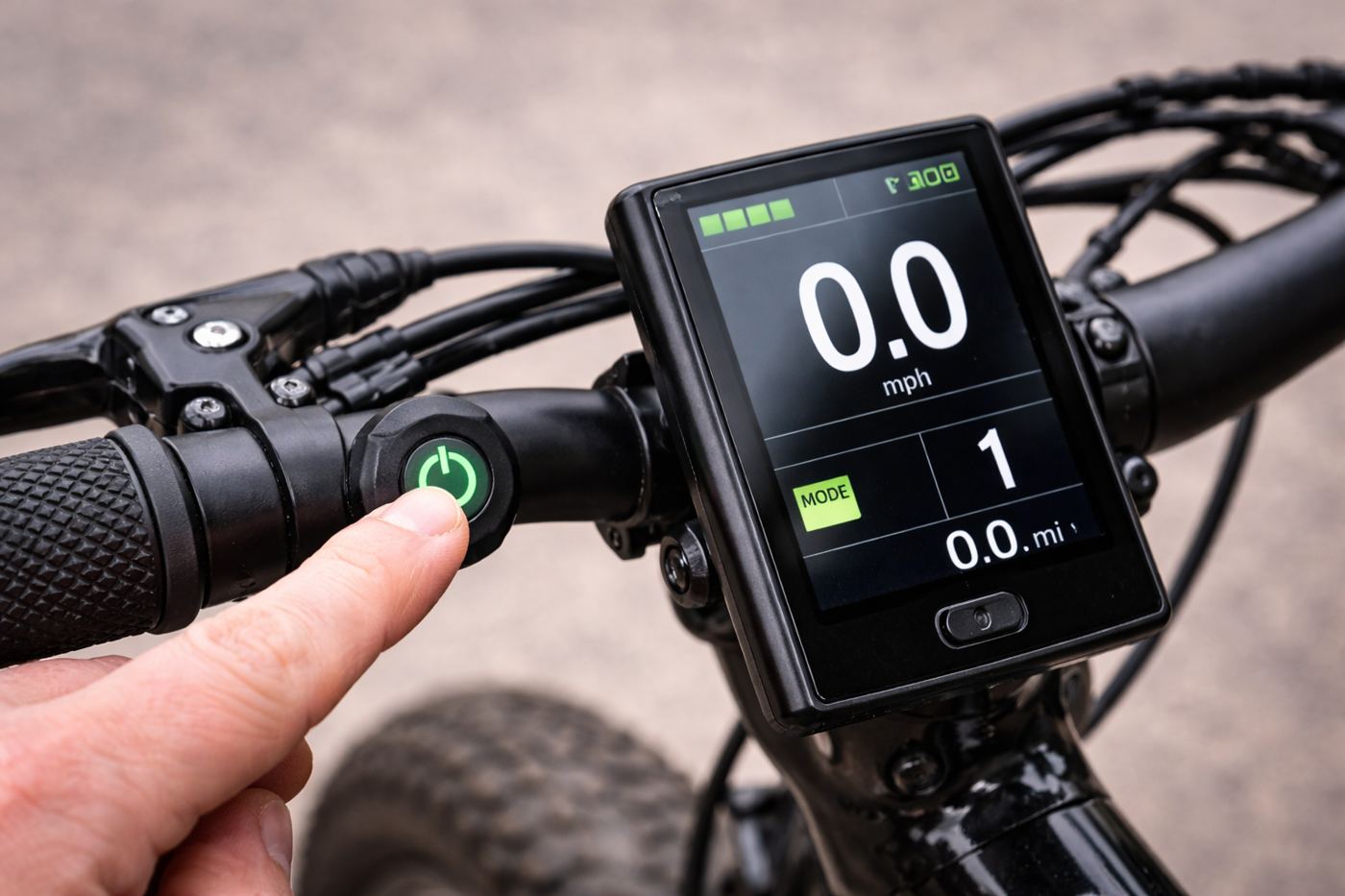
Plug the battery connector. Turn on the battery’s power switch if it has one. Hold the display power button for 2–3 seconds until the display activates. You should see voltage or battery level, assist level (usually 1), and wheel speed (0 at standstill). If the display does not light up, check the battery is charged and the main connector is fully seated.

Step 4 — Test PAS and throttle response

With the rear wheel in the air, pedal slowly by hand. The motor should engage within 1–2 crank rotations and spin the wheel. Release the pedals — the motor should stop within another half-rotation. Test each PAS level. If the motor does not engage, check the PAS sensor gap. If it does not stop promptly, check the disc is concentric.

Step 5 — Test brake cut-offs

With the motor running in PAS mode, squeeze each brake lever. Power must cut immediately. If power does not cut, check the brake sensor connection. Do not ride the bike until brake cut-offs are confirmed working on both levers.

11) Stage 8 — Controller Programming (UK EAPC)

The BBSHD ships from the factory with settings that are not UK road-legal and are also not optimised for most builds. Programming the controller is mandatory for public road use, and significantly improves pedal assist feel and battery efficiency regardless of legality.

You need a Bafang USB programming cable (available from our parts section) and a Windows PC running the Bafang Config Tool. The cable connects in place of the display connector while the battery is live.

Parameter Factory default UK road-legal setting
Speed limit 35+ km/h 25 km/h (15.5 mph)
Wheel diameter 26” Set to your actual wheel size
Low battery cutoff 41V 44V (48V battery) / 46V (52V battery)
PAS start current High (abrupt) Lower value for smoother assist onset
PAS stop delay 250ms 250ms (leave unchanged)
Speed sensor signals 1 Match to your magnet count (usually 1)
Not comfortable programming the controller yourself? We program every BBSHD build at our Cardiff workshop — EAPC spec for road use, or custom settings for off-road builds. We also offer standalone programming appointments for existing BBSHD owners. See our service menu or message us on WhatsApp.

12) Get Your BBSHD Fitted in Cardiff

We’re Cardiff’s dedicated eBike conversion workshop, based in Roath (CF24). We handle the full BBSHD installation — motor, battery, display, cable routing, chainline, and full EAPC programming — with a road test before handover. Carbon frames, non-standard BB shells, and complex builds welcome.

🔧 Full fitting service
Motor, battery, display, cable routing, chainline set, programming — all in our Roath workshop. Road builds leave configured to 250W EAPC spec.
⚡ Supply only
Prefer to DIY? We supply BBSHD kits with UK next-day delivery. Ask us on WhatsApp to confirm frame compatibility before ordering.
🔧 Repairs & programming
Already have a BBSHD and need it reprogrammed, repaired, or upgraded to a bigger battery? We handle those too — see our service menu.

Visit us: 2 Beresford Road Lane, Cardiff, CF24 1QU
Hours: Mon–Fri 11am–6pm  •  Sat 11am–3pm  •  Sun closed

FAQ

Will a BBSHD fit my standard mountain bike with a 68mm BB?
Not directly. The BBSHD requires a 100mm or 120mm BSA shell. A 68mm or 73mm shell is too narrow. Spacer adapters exist but are not reliable at BBSHD torque levels. If your frame has a 68mm BB, the BBS02B is the right motor to consider.
How long does a BBSHD installation take?
An experienced mechanic with the correct tools: 3–5 hours including programming and road test. A first-time installer working from a guide: allow a full day. The most time-consuming parts are BB shell preparation, cable routing, and PAS sensor adjustment.
What battery should I run with the BBSHD?
The BBSHD runs on 48V or 52V. Minimum recommended capacity: 17.5Ah (840Wh). For longer rides or sustained off-road use, 20Ah+ is better. A 52V battery gives noticeably better performance than 48V on an unrestricted BBSHD build — better acceleration, less voltage sag on climbs, and a flatter discharge curve. See our battery voltage guide for the full breakdown.
The motor is loose and rotating in the BB shell — what went wrong?
The inner M33 lock ring was not torqued to 50 Nm. Remove the motor, clean the shell and lock ring threads, apply fresh anti-seize, re-seat and re-torque to 50 Nm with a proper M33 socket. Check the retaining bracket is fully tightened. If the shell threads are stripped, the frame needs professional repair before the motor can be re-installed.
Is the BBSHD legal to ride on UK roads?
Yes — when programmed to UK EAPC specification: 250W maximum continuous assist, 25 km/h speed cutoff, pedal assist only. Un-programmed from the factory, or if de-restricted, the bike is off-road and private-land use only. All BBSHD road builds we carry out in Cardiff leave configured to EAPC spec as standard.
Can I fit a BBSHD to a carbon frame?
Yes, but it requires professional care. The 50 Nm lock ring torque can crack a carbon BB shell if the layup is insufficient. We handle carbon BBSHD builds at our Cardiff workshop and do not recommend DIY installation on carbon frames.

Got a question about your specific frame or build? Message us on WhatsApp with your frame details and we’ll give you a straight answer before you order anything.

Bafang BBSHD Installation Guide UK: Complete Step-by-Step Walkthrough

Get in touch!

footer-all4ebikes
ALL4EBIKES

Subscribe to our newsletter to get latest news on your inbox.

Copyright © 2026 All4Ebikes, All rights reserved.