Spend £600, Save £20
Spend £1000, Save £40
Spend £300, Save £10
UK Stock, next day delivery available!
Shopping Cart
No products in the cart.
E-Bike Battery Fully Charged But Not Working? Troubleshooting Guide
Troubleshooting • Batteries • E-Bike Guides

E-Bike Battery Fully Charged But Not Working? Complete Troubleshooting Guide

By All4eBikes Cardiff Updated June 2026 15 min read
Battery troubleshooting BMS faults Electric bike not turning on Blown fuse Controller faults Cardiff workshop
Quick answer: An e-bike battery fully charged but not working is almost always caused by a BMS protective shutdown, a fault in the power delivery chain, or a misleading charge indicator. The BMS, physical connectors, internal fuse, motor controller, and handlebar display must all function correctly for the bike to turn on — a failure at any single point leaves the system unresponsive even when the cells themselves are healthy.

1) Why This Happens — How Power Flows From Battery to Motor

At the heart of every lithium-ion pack sits a Battery Management System (BMS). This internal circuit board continuously monitors cell voltages, temperature, and current draw. If it detects anything outside safe parameters — extreme cold, a sudden voltage sag under load, or a significant imbalance between cell groups — it cuts the output entirely as a protective measure.

Beyond the BMS, the power delivery chain includes physical connectors, an internal fuse, the motor controller, and the handlebar display. A fault at any single point can leave the electric bike not turning on. Because the display only reports charge level rather than actual voltage under load, these failures are easy to misread as a dead battery when the real culprit may be something far simpler to fix.

2) Safety Checks Before You Start Troubleshooting

⚠️ Before touching any electrical component: Power down the e-bike completely and remove the battery from its mount. Work in a dry, well-lit, well-ventilated space away from flammable materials. Wear insulated gloves and safety glasses.

Stop immediately and seek professional help if you notice any of the following:

  • A visibly swollen, bulging, or cracked casing
  • Any chemical odour, smoke, or visible sparks
  • Excessive heat radiating from the pack when it has not been in use
  • Fluid leaking from the battery housing
⚠️ Thermal runaway risk: Never attempt to short the terminals or open the casing yourself. A damaged lithium-ion pack can ignite rapidly and is extremely difficult to extinguish.

3) Common Causes When Your Electric Bike Won’t Turn On

Blown internal fuse
When the fuse blows, the entire output circuit is broken. The battery may be perfectly healthy, but no current can leave it.
BMS protection mode
Triggered by extreme temperature, voltage sag, or cell group imbalance. The pack appears completely dead despite showing a full charge. Often recoverable.
Cell imbalance
Once the voltage gap between the weakest and strongest cell groups exceeds the BMS threshold, the system enters a protective lockout.
Controller or display fault
Water ingress, a pinched cable, or thermal damage can prevent the startup signal completing its circuit — even when the battery is outputting power correctly.
Faulty charger
Some chargers supply enough surface voltage to trigger the green LED without delivering the sustained current needed to complete a genuine charge cycle.
Loose or corroded connections
Road vibrations can work a battery loose over time. Even a slight misalignment of the contact pins is enough to break the circuit entirely.

4) Loose or Corroded Battery Connections

Reseating the battery is the simplest fix and should always be the first physical step. Remove the battery completely, wait thirty seconds, then firmly slide it back into the mount until you hear or feel a definite click.

While the battery is out, inspect the metal terminals on both the pack and the frame cradle for green or white oxidation, dirt, or moisture. Clean with a dry cloth or a small amount of isopropyl alcohol on a cotton bud, then allow to dry fully before reseating.

A half-seated battery may show a charge indicator but fail to complete the main discharge circuit — producing the classic fully-charged-but-not-working symptom. Always confirm a clear click before testing further.

5) Battery Management System Protection Mode

The BMS shuts down output when it detects:

  • Temperatures below 0°C or above 45°C
  • A voltage sag caused by a high-current demand the cells cannot sustain
  • A significant imbalance between cell groups within the pack
  • Extended storage at very low or zero charge

In many cases, simply connecting the battery to its charger for fifteen to twenty minutes supplies enough low-level current to wake the BMS from its sleep state.

6) Blown Fuse or Internal Circuit Breaker

Locate the fuse holder — typically found beneath a small rubber or plastic cap near the charging port or on the side of the battery casing. Remove the fuse and hold it up to a light source. A broken internal filament confirms it has blown.

⚠️ Important: Replace only with a new fuse of the identical amperage rating. Fitting a higher-rated fuse removes the protection the fuse is designed to provide and risks damaging the controller or motor.

7) Step-by-Step Troubleshooting Procedure

1
Verify the power source and charger behaviour

Plug the charger directly into a wall socket on a different circuit, bypassing any extension leads or surge-protected power strips. If the charger LED fails to illuminate at all, the charger itself is the likely fault.

2
Inspect the charging port

Use a torch to examine the battery’s charging socket. Look for bent pins, debris, corrosion, or moisture. Clean the port with a short burst of compressed air. Never insert metal objects into the socket.

3
Address a potential BMS deep-sleep lockout

If the battery has been stored for several months or was fully discharged to zero, leave it connected to the charger for at least twenty to thirty minutes. The trickle current is often sufficient to wake the system.

4
Check ambient temperature

Lithium-ion chemistry will not accept a charge outside approximately 0°C to 45°C. If the pack has been stored in a cold garage or left in direct sunlight, bring it indoors and allow it to reach room temperature first.

5
Test charging off the bike

If your battery is removable, disconnect it from the frame and charge it independently. If it charges successfully off the bike but not when mounted, the fault lies in the frame’s internal wiring or cradle connectors — not the battery itself.

6
Test charger output voltage with a multimeter

A healthy 48V charger should read approximately 54.6V at the output pins when unloaded. A 36V charger should read ~42V; a 52V charger ~58.8V. A reading significantly below this confirms the charger is faulty.

8) Test Battery Voltage With a Multimeter

Set the device to DC Voltage mode at a range above the battery’s nominal voltage. Touch the red probe to the positive terminal and the black probe to the negative terminal on the discharge connector.

Battery (Nominal)Expected Fully Charged ReadingInterpretation
36V41.5V to 42VHealthy and fully charged
48V54.0V to 54.6VHealthy and fully charged
52V58.0V to 58.8VHealthy and fully charged
Any0V or far below expectedBMS lockout or blown fuse
AnyWithin range, bike unresponsiveController or display fault

9) How to Reset the BMS

1
Disconnect and discharge the BMS capacitors

Disconnect the battery from the frame entirely. If the pack has a dedicated power button, hold it down for ten seconds.

2
Apply trickle charge

Reconnect the charger and leave it plugged in for fifteen minutes. This low-level input current frequently wakes a BMS from a protective sleep state.

3
Extended rest period

If that approach fails, leave the battery fully disconnected from both the bike and the charger for thirty minutes. This can clear temporary fault flags stored in the BMS memory.

If the system remains locked after all three steps, the BMS board itself needs professional diagnosis. Further reset attempts at home will not resolve a faulty BMS board.

10) Why Does My E-Bike Keep Cutting Out During Rides?

Voltage sag
Weak or imbalanced cells cannot sustain voltage under high current demand. The BMS cuts output temporarily, restoring power once the demand drops.
Thermal shutdown
The motor controller overheats during sustained high-power riding and shuts down temporarily, restarting after a few minutes of cooling.
Loose wiring connections
Connections borderline secure at rest can open intermittently under road vibration, causing momentary power interruptions.
Faulty throttle sensor
A stuck or worn throttle sensor generates erratic signals that the controller interprets as a fault condition, triggering a protective cutout.

11) Controller and Display Troubleshooting

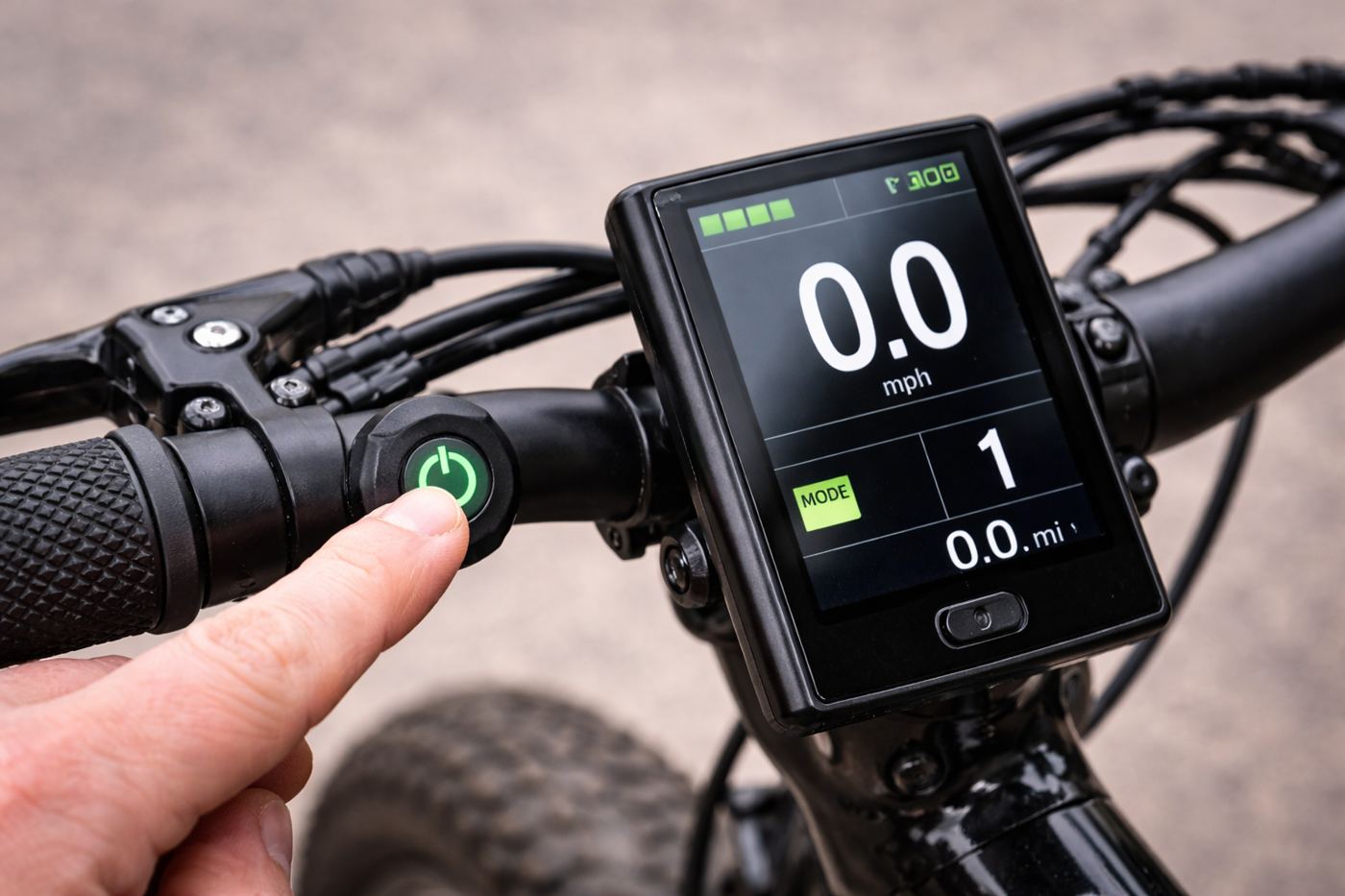
Start with the display. Check that the power button is not sticking due to dirt or moisture ingress — some systems require a press of five to ten seconds to initiate the startup sequence. Trace the display cable to the first connector junction, paying particular attention to the point where it enters the handlebar stem.

If the display powers on but the motor does not engage, the controller is the more likely fault. Perform a basic reset: power down the bike, disconnect the battery, and wait thirty seconds for the internal capacitors to discharge before reconnecting.

SymptomLikely FaultDiagnostic Action
Display does not power onDisplay unit, cable, or power buttonCheck button for sticking; trace cable to first connector junction
Display powers on, motor does not engageMotor controllerController reset; inspect housing for water damage or burning smell
Display and motor both unresponsiveBattery output or main wiring harnessTest battery voltage with multimeter; check main connector plugs

12) Battery Lifespan and Degradation Signs

Most quality packs are rated for 500 to 1,000 full charge cycles before capacity begins to degrade noticeably — typically two to five years depending on riding frequency and charging habits.

Key signs that degradation is responsible:
  • Reduced range: Riding range has dropped to less than 60% of the original specification
  • Faster discharge: The battery discharging noticeably faster than when new, even on flat terrain
  • Frequent BMS cutouts: Cutouts under moderate load that were not present previously
  • Rapid self-discharge: A pack that loses significant charge within a day or two of being unplugged
  • Physical swelling: Swelling of the casing, indicating gas build-up from degraded cells

13) When to Replace Your E-Bike Battery

IndicatorDetail
Severe range lossRange declined to less than half the original figure and does not improve after a full charge cycle
Poor charge retentionBattery fails to hold charge for more than a few hours after being unplugged
Consistent power cutoutsCutouts occur consistently under moderate load despite clean connections and a healthy controller
Physical damageCasing is visibly swollen, cracked, or shows signs of leakage
Repeated fuse failureA replacement fuse blows immediately after installation, indicating an internal short circuit

All4eBikes stocks replacement lithium-ion batteries in 36V, 48V, 52V, and 72V configurations, with guidance on matching the right pack to your specific conversion kit or factory e-bike.

14) Preventive Maintenance to Avoid Battery Problems

Storage
Store the battery at between 40% and 70% charge in a cool, dry indoor location if the bike will be unused for more than two weeks. Avoid cold garages in winter and hot car boots in summer.
Charging habits
Allow the battery to cool for at least thirty minutes after a ride before connecting the charger. Use only the charger supplied with the battery or a manufacturer-approved equivalent.
Depth of discharge
Avoid regularly draining the pack to zero. Lithium-ion cells last significantly longer when kept between 20% and 80% charge for everyday use.
Terminal maintenance
Inspect the battery terminals and cradle contacts every month. Clean any oxidation or moisture with isopropyl alcohol and a cotton bud.
🔧 Cardiff workshop — All4eBikes
We offer professional e-bike battery diagnostic and repair services at 2 Beresford Road Lane, Cardiff CF24 1QU.
Hours: Mon–Fri 11am–6pm  •  Sat 11am–3pm  •  Sun closed

FAQ

Why is my e-bike battery fully charged but not working?
The most common causes are a BMS protective shutdown (triggered by extreme temperature, voltage sag, or cell imbalance), a blown internal fuse, loose or corroded battery contacts, or a fault in the motor controller or display. The battery cells may be perfectly healthy while the output circuit is broken at another point in the chain.
How do I reset the BMS on my e-bike battery?
Disconnect the battery from the bike entirely. If it has a power button, hold it down for 10 seconds. Reconnect the charger and leave it plugged in for 15–20 minutes. If that fails, leave the battery fully disconnected for 30 minutes to clear temporary fault flags.
What voltage should a fully charged 48V e-bike battery read?
A healthy, fully charged 48V battery should read 54.0V to 54.6V on a multimeter set to DC voltage mode. A reading of 0V or far below this range indicates a BMS lockout or blown fuse. A reading within the expected range with the bike still unresponsive points to a controller or display fault.
Why does my e-bike keep cutting out during rides?
Most commonly caused by voltage sag — weak or imbalanced cells cannot sustain voltage under high current demand, so the BMS cuts output temporarily. Other causes include thermal shutdown of the motor controller, loose wiring connections that open under road vibration, or a faulty throttle sensor.
When should I replace my e-bike battery?
Consider replacement when riding range has declined to less than half the original figure, the battery fails to hold charge for more than a few hours after unplugging, power cutouts occur consistently under moderate load, the casing is visibly swollen or cracked, or a replacement fuse blows immediately after fitting.

Not sure whether your battery needs repair or replacement? Message us on WhatsApp with a description of the fault and we’ll give you an honest assessment before you spend anything.

E-Bike Battery Fully Charged But Not Working? Troubleshooting Guide

Get in touch!

footer-all4ebikes
ALL4EBIKES

Subscribe to our newsletter to get latest news on your inbox.

Copyright © 2026 All4Ebikes, All rights reserved.